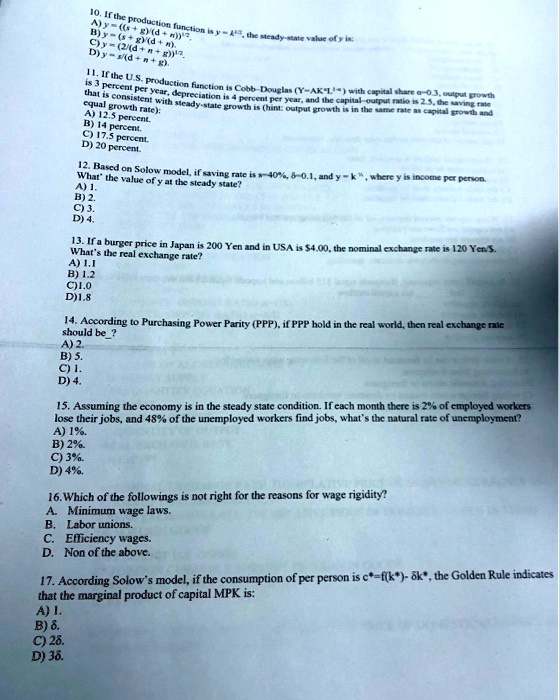
10. If the production function is Ay=(s+g/d+n^2), Dy=s/d+n+g, and Cy=2/(d+n+g^2) with equal growth rate: A) 12.5 percent, B) 14 percent, C) 17.5 percent, D) 20 percent.
A1. What is the value of y at the steady state? B) 2, C) 3, D) 4.
What is the real exchange rate? A) 1.1, B) 1.2, C) 1.0, D) 1.8.
Should it be A) 2, B) 5, C) 1, D) 4?
15. Assuming the economy is in the steady state condition, if each month 2% of employed workers lose their jobs and 48% of the unemployed workers find jobs, what is the natural rate of unemployment? A) 1%, B) 2%, C) 3%, D) 4%.
16. Which of the following is not right for the reasons for wage rigidity? A) Minimum wage laws, B) Labor unions, C) Efficiency wages, D) None of the above.
17. According to Solow's model, if the consumption per person is c*=f(k*)-k*, the Golden Rule indicates that the marginal product of capital (MPK) is: A) 1, B) 2, C) 28, D) 36.