Problem 3: Predator-Prey Model
Consider Predator-Prey Model
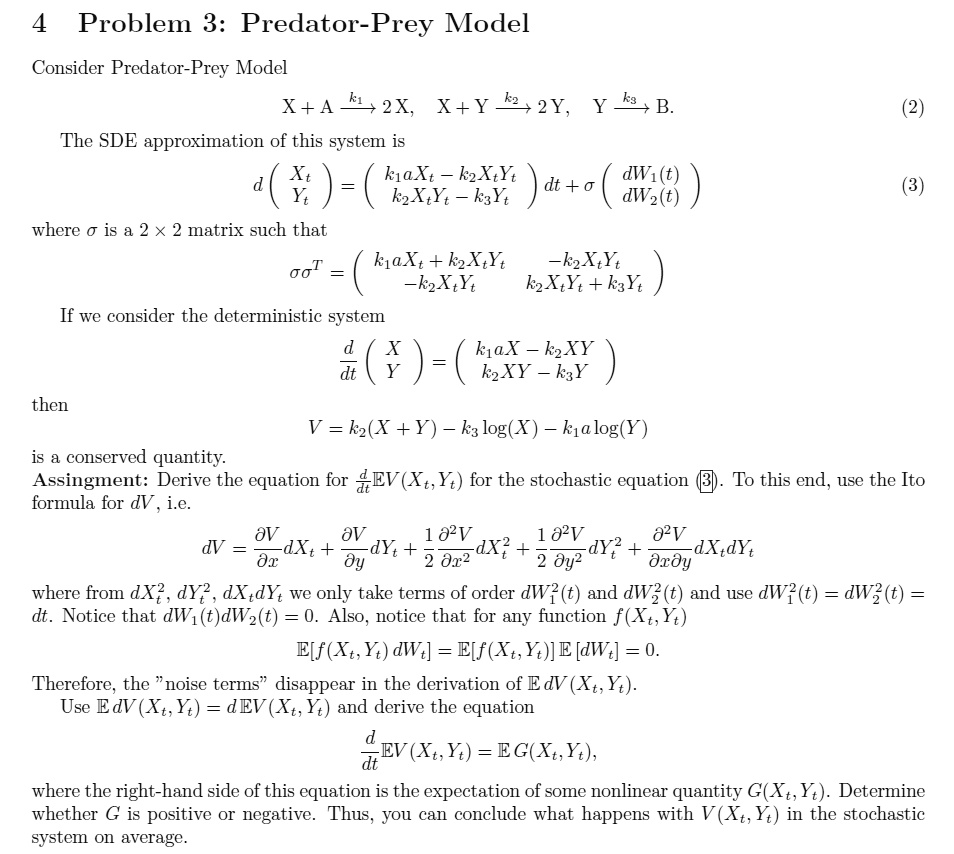
X+A->2X, X+Y->2Y, Y->B.
The SDE approximation of this system is
d([X(t)],[Y(t)])=([k1aX(t)-k2X(t)Y(t)],[k2X(t)Y(t)-k3Y(t)])dt+σ([dW1(t)],[dW2(t)])
where σ is a 2x2 matrix such that
σσ^T=([k1aX(t)+k2X(t)Y(t),-k2X(t)Y(t)],[-k2X(t)Y(t),k2X(t)Y(t)+k3Y(t)])
If we consider the deterministic system
(d)/(dt)(X,Y)=([k1aX-k2XY],[k2XY-k3Y])
then
V=k2(X+Y)-k3log(X)-k1log(Y)
is a conserved quantity.
Assignment: Derive the equation for (d)/(dt)EV(X(t),Y(t)) for the stochastic equation (3). To this end, use the Ito formula for dV, i.e.
dV=(∂V)/(∂X)dX(t)+(∂V)/(∂Y)dY(t)+(1/2)(∂^2V)/(∂X^2)dX(t)^2+(1/2)(∂^2V)/(∂Y^2)dY(t)^2+(∂^2V)/(∂X∂Y)dX(t)dY(t)
where from dX(t)^2, dY(t)^2, dX(t)dY(t) we only take terms of order dW1(t)^2 and dW2(t)^2 and use dW1(t)^2=dW2(t)^2=dt. Notice that dW1(t)dW2(t)=0. Also, notice that for any function f(X(t),Y(t))
E[f(X(t),Y(t))dW(t)]=E[f(X(t),Y(t))]E[dW(t)]=0.
Therefore, the "noise terms" disappear in the derivation of EdV(X(t),Y(t)). Use EdV(X(t),Y(t))=dEV(X(t),Y(t)) and derive the equation
(d)/(dt)EV(X(t),Y(t))=EG(X(t),Y(t)),
where the right-hand side of this equation is the expectation of some nonlinear quantity G(X(t),Y(t)). Determine whether G is positive or negative. Thus, you can conclude what happens with V(X(t),Y(t)) in the stochastic system on average.