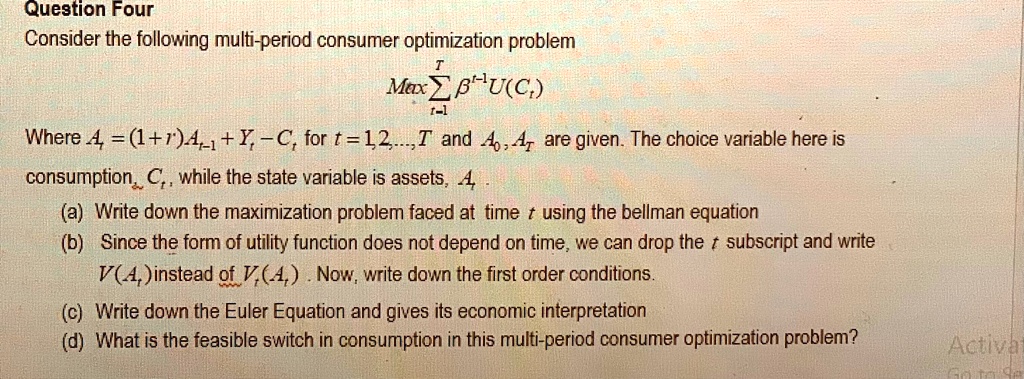
Question Four
Consider the following multi-period consumer optimization problem
\begin{equation}
\label{eq:1} \max \sum_{t=1}^{T} \beta^{t-1} U(C_t)
\end{equation}
Where $A_t = (1+r^t)A_{t-1} + Y_t - C_t$ for $t = 1,2,...,T$ and $A_0, A_T$ are given. The choice variable here is
consumption, $C_t$, while the state variable is assets, $A_t$.
(a) Write down the maximization problem faced at time $t$ using the bellman equation
(b) Since the form of utility function does not depend on time, we can drop the $t$ subscript and write
$V(A_t)$ instead of $V_t(A_t)$. Now, write down the first order conditions.
(c) Write down the Euler Equation and gives its economic interpretation
(d) What is the feasible switch in consumption in this multi-period consumer optimization problem?