Ace - AI Tutor
Ask Our Educators
Textbooks
My Library
Flashcards
Scribe - AI Notes
Notes & Exams
Download App
johnny miller

johnny m.

Divider

Questions asked

BEST MATCH

The consensual response, or any reflex observed on one side of the body when the other side has been stimulated, is called a contralateral response. The pupillary light response, or any reflex occurring on the same side stimulated, is referred to as an ipsilateral response. What does the occurrence of a contralateral response indicate about the pathways involved? _____________________________________________________ _____________________________________________________ What is the function of these pupillary responses?

View Answer
divider
BEST MATCH

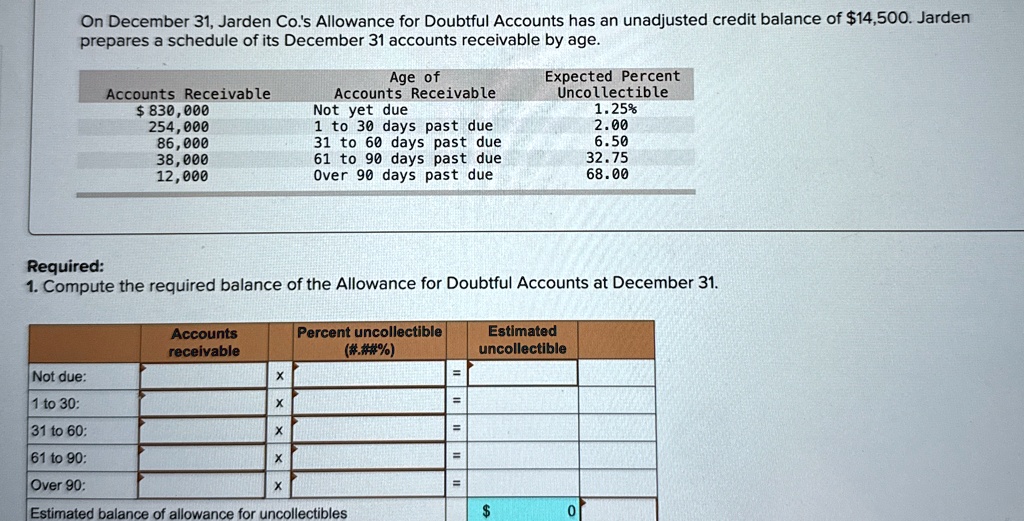
On December 31, Jarden Co.'s Allowance for Doubtful Accounts has an unadjusted credit balance of $14,500. Jarden prepares a schedule of its December 31 accounts receivable by age. Accounts Receivable Age of Accounts Receivable Expected Percent Uncollectible $830,000 Not yet due 1.25% 254,000 1 to 30 days past due 2.00 86,000 31 to 60 days past due 6.50 38,000 61 to 90 days past due 32.75 12,000 Over 90 days past due 68.00 Required: 1. Compute the required balance of the Allowance for Doubtful Accounts at December 31. Accounts receivable Percent uncollectible (#.##%) Estimated uncollectible Not due: X = 1 to 30: X = 31 to 60: X = 61 to 90: X = Over 90: X = Estimated balance of allowance for uncollectibles $ 0
View Answer
divider
BEST MATCH

For the Ch3 HW 48 problem, please complete the following steps 1. Using the tree method. Show the tree at the end of each step. 2. Using the table method. Create a table that shows (for each node): 1. The total distance from node D 2. The next node (via) The main difference between the methods • the first method shows all possible known nodes as dashed-possibilities and picks the shortest one (making the selection a solid line) • the second method always picks the next node by selecting the next destination node with the next shortest total distance from the source node to next destination node, but ignores nodes that aren't the next shortest total distance Like we discussed at the end of class, if two nodes have the same next shortest total distance from source node, just pick one. Both methods will generate the same optimal outcome (shortest total distances from a source node to all other nodes) regardless of which of the equal total distance nodes that you pick next. 48. For the network given in Figure 3.53, show how Dijkstra's shortest-path algorithm builds the routing table for node D. Create a routing database (table) similar to Table 3.14 on page 258. (You may find it more useful to number the steps as listed in the algorithm on page 257.) Illustrate the progression of the algorithm using Radia Perlman's technique as illustrated on slides 7-8 through 7-14. Draw one tree for each pass through the algorithm. After each iteration, also create the resulting routing table (similar to the routing table on slide 7-14). The tree for the first pass is shown below. The tables and trees may be drawn by hand and scanned or photographed for submission to Canvas. (10 points) 3 A C 6 8 1 B 2 D E 2 End of Pass 1* D Next 8 2 A E Neighbor Neighbor Figure 3.53 Network for Exercises 46, 48 and 54.

View Answer
divider
BEST MATCH

When considering a Type I error: OA. The probability of occurrence is denoted by Beta (β) OB. The power of a test determines the probability of a Type I error OC. Should be set so that investigators always reject the null hypothesis. OD. Such an error is made when we reject Ho given the Ho is true

View Answer
divider
BEST MATCH

Instead of borrowing money from suppliers to purchase equipment, an increasing number of small businesses are making these purchases outright. obtaining trade credit instead. opting to streamline assembly processes to reduce expenditures. choosing to lease the equipment.

View Answer
divider
BEST MATCH

Question 2 (0.5 points) Can diffusion occur across a permeable membrane? Yes No

View Answer
divider
BEST MATCH

Cholinesterase inhibitors are most likely used to treat which condition? a. Parkinson's disease b. Alzheimer's disease c. Seizure disorder d. Myasthenia Gravis

View Answer
divider
BEST MATCH

(a) When the potential difference across the device is 1 V, what is its resistance? (b) When the potential difference across the device is 2 V, what is its resistance? (c) When the potential difference across the device is 4 V, what is its resistance?

View Answer
divider
BEST MATCH

QUESTION 15 "After all the lines of a file have been read, the readline method returns _______." O the empty string O an empty tuple O the value None O a Throwback error

View Answer
divider
BEST MATCH

Match the protocol data unit (PDU) that correspond to each TCP/IP layer Layer 1 Layer 2 Layer 3 Layer 4 [Choose] [Choose] [Choose] [Choose] Message Voltage Frames Segments Bits / Symbols Data Intensity Packages Packets

View Answer
divider