Ace - AI Tutor
Ask Our Educators
Textbooks
My Library
Flashcards
Scribe - AI Notes
Notes & Exams
Download App
jon peters

jon p.

Divider

Questions asked

BEST MATCH

All sphingolipids contain: a glycerol backbone. two fatty acid chains. the amino alcohol sphingosine. a sugar-containing head group. all of the above components.

View Answer
divider
BEST MATCH

Q3 (10 points) Write an argument illustrating that the following sets $S$ are NOT subspaces of $\mathbb{R}^n$. Be sure to specifically state what property does not hold and provide an appropriate counterexample. a) Let $\vec{v}_1 = \begin{bmatrix} 1 \\ -1 \\ 1 \end{bmatrix}$ and $\vec{v}_2 = \begin{bmatrix} 2 \\ 1 \\ 2 \end{bmatrix}$. Let $S = \{\vec{x} \in \mathbb{R}^3 | \vec{x} \cdot \vec{v}_1 = 0 \text{ or } \vec{x} \cdot \vec{v}_2 = 0\}$. b) $S = \left\{ \begin{bmatrix} x_1 \\ x_2 \end{bmatrix} | x_1 \ge 0, -x_1 \le x_2 \le x_1 \right\}$.

View Answer
divider
BEST MATCH

the complex ion Cu(NH3)4 is formed in a solution to make 0.0300 CuNO3 and 0.500 NH3

View Answer
divider
BEST MATCH

5. Bonus Credit Function: Write a Python function called "PrimeBonus" with one input for the filename to write output data. This function should use the output from the prime function (Problem 3). The function loops through all values of n from 1 to 1000 and calculates the value of $n^{th}$ prime - p(n). Your function needs to truncate the value of this difference to one decimal place. To the output filename, the function should write the value of n in the first column and the truncated difference or error in the second column. The first line in the output file should have column headings of "n" and "Error". The bonus credit function will be graded more harshly than the other functions in this homework. If this function does work you will get zero bonus points.

View Answer
divider
BEST MATCH

The $\boxed{ sclerotome }$ is derived from the ventral somite and generates the chondrocytes that produce the ribs.

View Answer
divider
BEST MATCH

Two masses $m_1 = 7 \, kg$ and $m_2 = 6 \, kg$ are attached by a spring and rest on a frictionless table. The masses are at rest and the spring unstretched when a force $F = 78 \, N$ is applied to the second mass. (a) What is the acceleration of $m_2$ the instant the force is applied, before the spring can stretch? (b) What is the acceleration of the system's center of mass the instant that the spring reaches its maximum stretch? (c) What is the speed of the system's center of mass 8 seconds after the force is first applied?

View Answer
divider
BEST MATCH

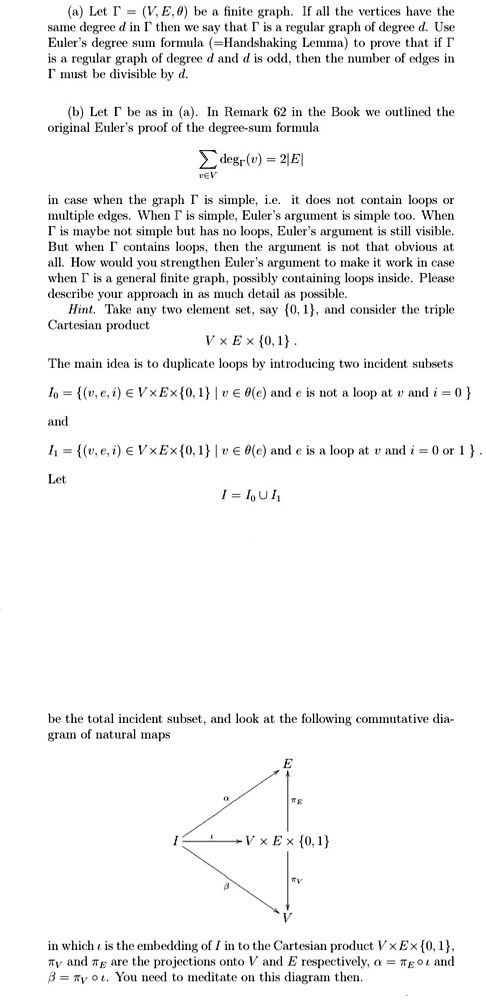
(a) Let ? = (V, E, ?) be a finite graph. If all the vertices have the same degree d in ? then we say that ? is a regular graph of degree d. Use Euler's degree sum formula (=Handshaking Lemma) to prove that if ? is a regular graph of degree d and d is odd, then the number of edges in ? must be divisible by d. (b) Let ? be as in (a). In Remark 62 in the Book we outlined the original Euler's proof of the degree-sum formula $\sum_{v \in V} deg_?(v) = 2|E|$ in case when the graph ? is simple, i.e. it does not contain loops or multiple edges. When ? is simple, Euler's argument is simple too. When ? is maybe not simple but has no loops, Euler's argument is still visible. But when ? contains loops, then the argument is not that obvious at all. How would you strengthen Euler's argument to make it work in case when ? is a general finite graph, possibly containing loops inside. Please describe your approach in as much detail as possible. Hint. Take any two element set, say {0, 1}, and consider the triple Cartesian product V × E × {0, 1}. The main idea is to duplicate loops by introducing two incident subsets $I_0 = \{(v, e, i) \in V \times E \times \{0, 1\} \mid v \in \theta(e) \text{ and } e \text{ is not a loop at } v \text{ and } i = 0\}$ and $I_1 = \{(v, e, i) \in V \times E \times \{0, 1\} \mid v \in \theta(e) \text{ and } e \text{ is a loop at } v \text{ and } i = 0 \text{ or } 1\}$. Let $I = I_0 \cup I_1$ be the total incident subset, and look at the following commutative diagram of natural maps (diagram) in which ? is the embedding of I in to the Cartesian product V × E × {0, 1}, ?v and ?E are the projections onto V and E respectively, ? = ?? ? ? and ? = ?v ? ?. You need to meditate on this diagram then.
View Answer
divider
BEST MATCH

3. Rank the following compounds from lowest to highest heat of hydrogenation (1 being the lowest).

View Answer
divider
BEST MATCH

People who process information through careful, conscious processing are considered to be using which system of thinking?

View Answer
divider
BEST MATCH

Parameter CSTR Volume GPR Temperature Minimum 20 L 273 K Maximum 500 L 423 K You are to examine the effectiveness of the proposed process to produce product D as a function of the CSTR reactor volume, and the operating temperature of the GPR. The reactor designs allow you to consider conditions within the aforementioned limits (also listed on the right table). Tasks: 1. Draw and label a block flow diagram for the entire process containing the three process units described. 2. Write down all equations to solve for each unknown flow rate for the entire process, including the CSTR, separator, and GPR, at any given volume of the CSTR ($V_{CSTR}$) and any given operating temperature of the GPR ($T_{GPR}$). No need to solve by hand.

View Answer
divider