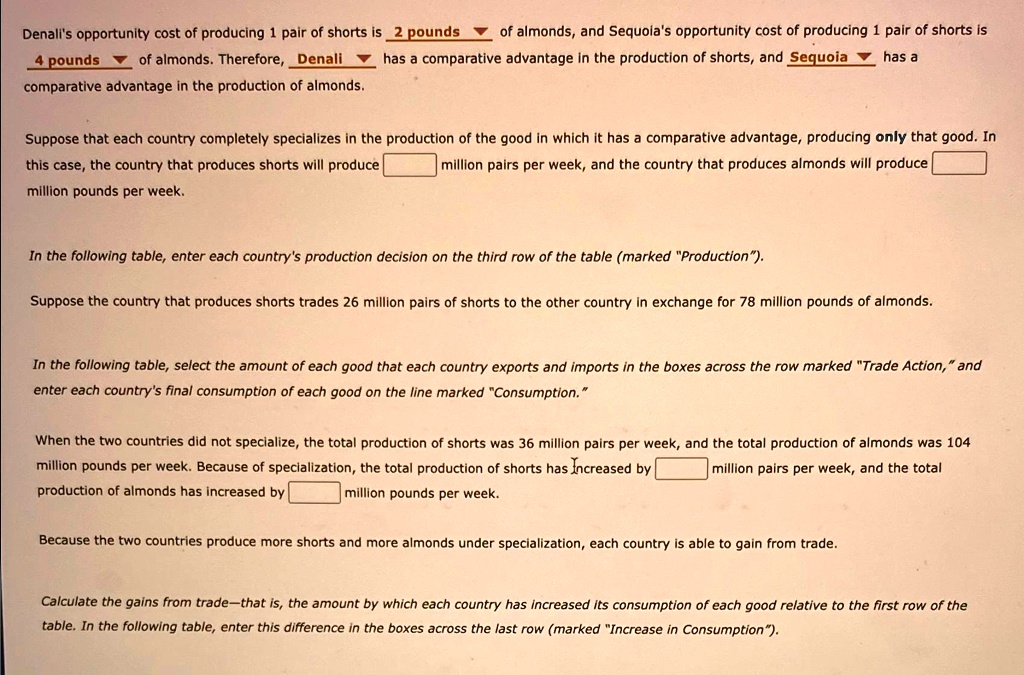
Denali's opportunity cost of producing 1 pair of shorts is 2 pounds of almonds, and Sequoia's opportunity cost of producing 1 pair of shorts is
4 pounds of almonds. Therefore, Denali has a comparative advantage in the production of shorts, and Sequoia has a
comparative advantage in the production of almonds.
Suppose that each country completely specializes in the production of the good in which it has a comparative advantage, producing only that good. In
this case, the country that produces shorts will produce million pairs per week, and the country that produces almonds will produce
million pounds per week.
In the following table, enter each country's production decision on the third row of the table (marked "Production").
Suppose the country that produces shorts trades 26 million pairs of shorts to the other country in exchange for 78 million pounds of almonds.
In the following table, select the amount of each good that each country exports and imports in the boxes across the row marked "Trade Action," and
enter each country's final consumption of each good on the line marked "Consumption."
When the two countries did not specialize, the total production of shorts was 36 million pairs per week, and the total production of almonds was 104
million pounds per week. Because of specialization, the total production of shorts has Increased by million pairs per week, and the total
production of almonds has increased by million pounds per week.
Because the two countries produce more shorts and more almonds under specialization, each country is able to gain from trade.
Calculate the gains from trade--that is, the amount by which each country has increased its consumption of each good relative to the first row of the
table. In the following table, enter this difference in the boxes across the last row (marked "Increase in Consumption").