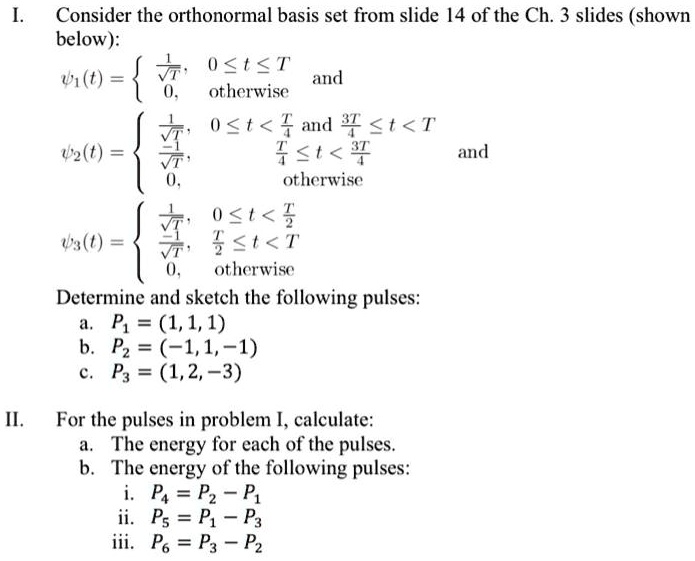
I. Consider the orthonormal basis set from slide 14 of the Ch. 3 slides (shown
below):
$\psi_1(t) = \begin{cases} \frac{1}{\sqrt{T}}, & 0 \le t \le T \\ 0, & \text{otherwise} \end{cases}$ and
$\psi_2(t) = \begin{cases} \frac{1}{\sqrt{T}}, & 0 \le t < \frac{T}{4} \text{ and } \frac{3T}{4} \le t < T \\ -\frac{1}{\sqrt{T}}, & \frac{T}{4} \le t < \frac{3T}{4} \\ 0, & \text{otherwise} \end{cases}$ and
$\psi_3(t) = \begin{cases} \frac{1}{\sqrt{T}}, & 0 \le t < \frac{T}{2} \\ -\frac{1}{\sqrt{T}}, & \frac{T}{2} \le t < T \\ 0, & \text{otherwise} \end{cases}$
Determine and sketch the following pulses:
a. $P_1 = (1, 1, 1)$
b. $P_2 = (-1, 1, -1)$
c. $P_3 = (1, 2, -3)$
II. For the pulses in problem I, calculate:
a. The energy for each of the pulses.
b. The energy of the following pulses:
i. $P_4 = P_2 - P_1$
ii. $P_5 = P_1 - P_3$
iii. $P_6 = P_3 - P_2$