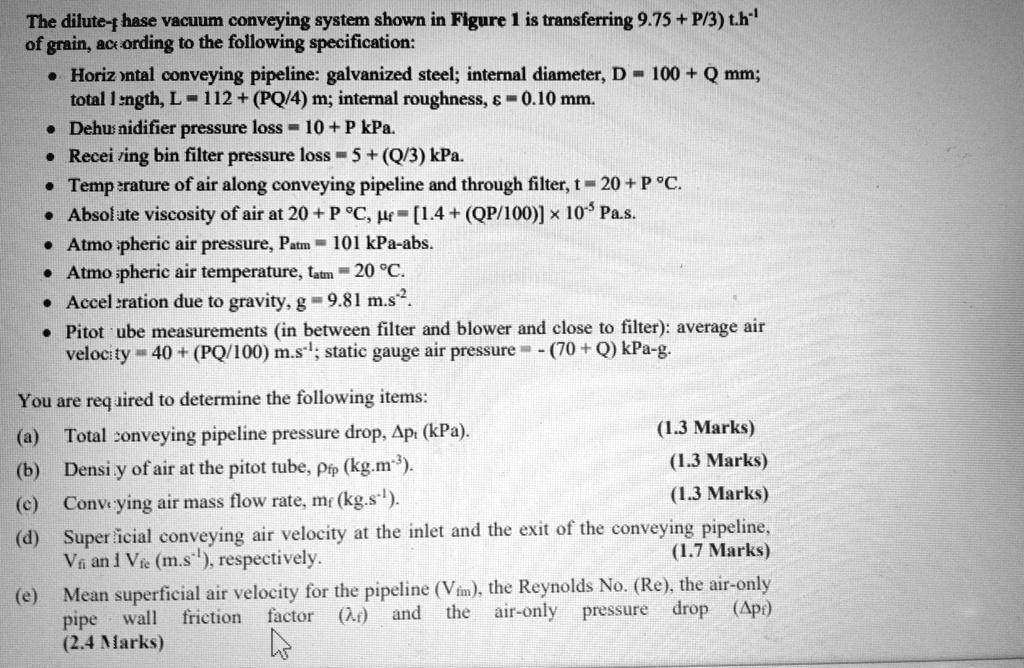
The dilute-phase vacuum conveying system shown in Figure 1 is transferring 9.75 + P/3 t.h- of grain, according to the following specification: Horizontal conveying pipeline: galvanized steel internal diameter D = 100 + Q mm total length L = 112 + PQ/4 m; internal roughness, g = 0.10 mm Dehumidifier pressure loss = 10 + P kPa Receiving bin filter pressure loss = 5 + Q/3 kPa Temperature of air along conveying pipeline and through filter, t = 20 + p C. Absolute viscosity of air at 20 + P C = [1.4 + QP/100]10 Pa.s Atmospheric air pressure, Patm = 101 kPa-abs Atmospheric air temperature, tatm = 20 C. Acceleration due to gravity, g = 9.81 m/s Pitot tube measurements in between filter and blower and close to filter: average air velocity = 40 + PQ/100 m/s; static gauge air pressure = -70 + Q kPa-g
You are required to determine the following items: Total conveying pipeline pressure drop, p kPa 1.3 Marks (a) (b) Density of air at the pitot tube, Pfp kg.m 1.3 Marks) Conveying air mass flow rate, mf kg.s 1.3 Marks) (c) (d) Superficial conveying air velocity at the inlet and the exit of the conveying pipeline, V an 1Vfem.s, respectively 1.7 Marks) (e) Mean superficial air velocity for the pipeline (Vm, the Reynolds No. Re, the air-only pipe wall friction factor, and the air-only pressure drop (2.4 Marks)