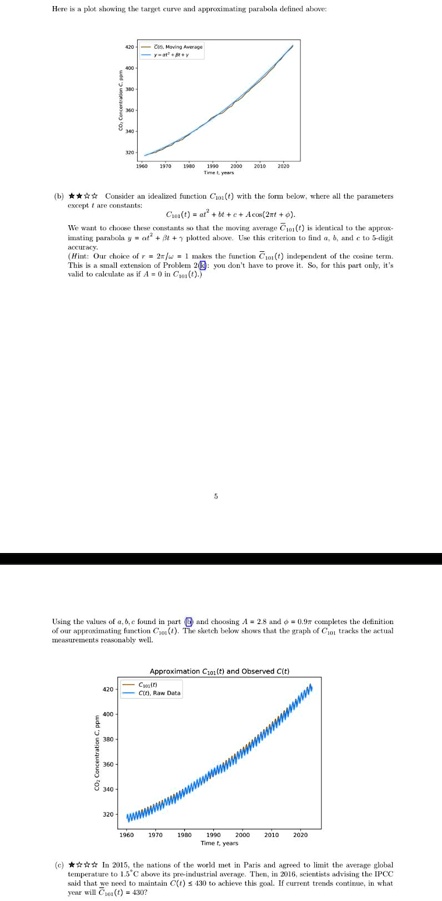
Here is a plot showing the target curve and approximating parabola defined above:
(b) Consider an idealized function C_(101)(t) with the form below, where all the parameters except t are constants:
C_(101)(t) = at^(2) + bt + c + Acos(2πt + φ).
We want to choose these constants so that the moving average /bar(C)_(101)(t) is identical to the approximating parabola y = αt^(2) + βt + γ plotted above. Use this criterion to find a, b, and c to 5-digit accuracy.
(Hint: Our choice of r = 2π/ω = 1 makes the function /bar(C)_(101)(t) independent of the cosine term. This is a small extension of Problem 2(k: you don't have to prove it. So, for this part only, it's valid to calculate as if A = 0 in C_(101)(t).)
Using the values of a, b, c found in part (b) of our approximating function C_(101)(t). The sketch below shows that the graph of C_(101) tracks the actual measurements reasonably well.
(c) In 2015, the nations of the world met in Paris and agreed to limit the average global temperature to 1.5°C above its pre-industrial average. Then, in 2016, scientists advising the IPCC said that we need to maintain C(t) <= 430 to achieve this goal. If current trends continue, in what year will /bar(C)_(101)(t) = 430?