Ace - AI Tutor
Ask Our Educators
Textbooks
My Library
Flashcards
Scribe - AI Notes
Notes & Exams
Download App
jorge rodriguez

jorge r.

Divider

Questions asked

BEST MATCH

Which of the following follows an ultradian rhythm? Daily melatonin release Daily activity patterns of sleep and wake for hamsters Daily body temperature Pain sensitivity under hypnosis A typical night's sleep in an adult human

View Answer
divider
BEST MATCH

1. Consider the two communities of insects shown at the right to answer questions below. Site A Site B a. Calculate the Shannon diversity index for each community. b. Draw a rank abundance curve for each of the communities. c. Which community is the most diverse when taking into account species richness and evenness? Site C Site D 2. How do we measure diversity at different spatial scales? How do these different types of diversity influence each other? 3. What is the difference between 'top down' and 'bottom up' trophic interactions? We have discussed

View Answer
divider
BEST MATCH

For the function $y = f(x) = x^2 + 4x - 4$, $x \ge -2$, find $\frac{df^{-1}}{dy}|_{y=3}$ $(f^{-1})'(3) = $

View Answer
divider
BEST MATCH

In $\mathbb{R}^3$ you are given the vectors $x = (14, -5, 9)$ $y = (\frac{35}{2}, -\frac{25}{4}, s)$ Choose $s$ such that $x$ and $y$ are parallel. Answer (enter your answer as a fraction, not a decimal number): $s = $

View Answer
divider
BEST MATCH

1) The entropy of a pure, perfect crystalline substance at absolute zero (0 K) is zero. 2) Thermodynamic state function that is associated with the extent of disorder in a system or how energy of a reaction gets distributed across the molecules. 3) For any irreversible and spontaneous process, the entropy of the universe increases. 4) ASUniv<0 5) AS univ> 0 6) A particular combination of motions and locations of the atoms and molecules of a system at a particular instant 7) Energy can be converted from one form to another, but cannot be created or destroyed 8) S=k(ln W) where k = 1.38 x 10^-23 J/K 9) AS univ=0

View Answer
divider
BEST MATCH

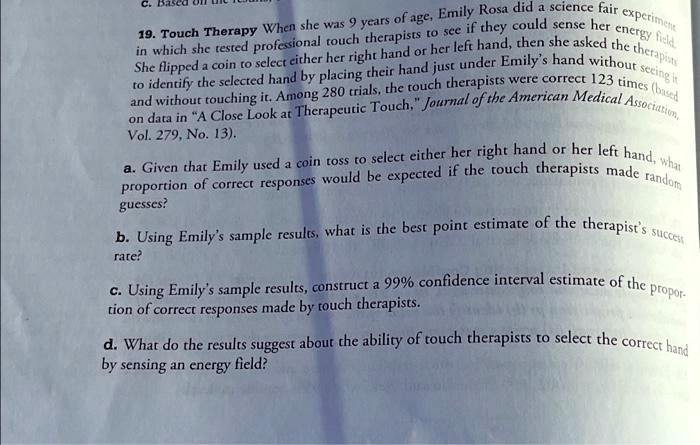
c. Based to select either her right hand or 19. Touch Therapy When she was 9 years of age, Emily Rosa did a science fair experiment in which she tested professional touch therapists to see if they could sense her energy field. She flipped a coin to select either her right hand or her left hand, then she asked the therapists to identify the selected hand by placing their hand just under Emily's hand without seeing it and without touching it. Among 280 trials, the touch therapists were correct 123 times (based on data in "A Close Look at Therapeutic Touch," Journal of the American Medical Association, Vol. 279, No. 13). a. Given that Emily used a coin toss to select either her right hand or her left hand, what proportion of correct responses would be expected if the touch therapists made random guesses? b. Using Emily's sample results, what is the best point estimate of the therapist's success rate? c. Using Emily's sample results, construct a 99% confidence interval estimate of the propor- tion of correct responses made by touch therapists. d. What do the results suggest about the ability of touch therapists to select the correct hand by sensing an energy field?
View Answer
divider
BEST MATCH

500 ? 5V 1 k? R? V? Figure 2

View Answer
divider
BEST MATCH

How is blood flow in the pulmonary system regulated? Blood goes toward ventilated alveoli because pulmonary vascular smooth muscle relaxes when the partial pressure of oxygen is high. Blood goes toward ventilated alveoli because pulmonary vascular smooth muscle relaxes when the partial pressure of carbon dioxide is high. Blood goes toward perfused alveoli because pulmonary vascular smooth muscle relaxes when the partial pressure of oxygen is high. Blood goes toward perfused alveoli because pulmonary smooth muscle relaxes when the partial pressure of oxygen is high.

View Answer
divider
BEST MATCH

Table 9.3 For a Cylindrical Pressure Vessel, Leak-before-Break Critical Crack Lengths for 10 Metal Alloys.* cc (Leak-before-Break) (mm) Alloy Steel alloy 1040 6.6 Steel alloy 4140 (tempered at 370°C) 6.8 (tempered at 482°C) 12.7 (LBB) Steel alloy 4340 (tempered at 260°C) 5-7 (tempered at 425°C) 17.3 (LBB) Stainless steel 17-4PH 6.4 Aluminum alloy 2024-T3 4.4 Aluminum alloy 7075-T651 1.3 Magnesium alloy AZ31B 1.8 Titanium alloy Ti-5Al-2.5Sn 11.5 (LBB) Titanium alloy Ti-6Al-4V 4.4 *The \"LBB\" notation identifies those alloys that meet the leak-before-break criterion for this problem. The \"(LBB)\" label appears beside the critical crack lengths for these three alloys. (b) For an alloy that does not meet the leak-before-break conditions brittle fracture can occur when, during crack growth, c reaches the critical crack length $c_c$. Therefore, brittle fracture is likely for the remaining eight alloys in Table 9.3.

View Answer
divider
BEST MATCH

Hosmer and Lemeshow Test Step Chi-square df 1 5.552 7 Classification Table<sup>a</sup> Predicted Y Percentage Observed 0 1 Correct Step 1 Y 0 8 5 61.5 1 3 11 78.6 Overall Percentage 70.4 <sup>a</sup> The cut value is .500 Variables in the Equation B S.E. Step 1<sup>a</sup> X .019 .008 Constant -10.309 4.377

View Answer
divider