Ace - AI Tutor
Ask Our Educators
Textbooks
My Library
Flashcards
Scribe - AI Notes
Notes & Exams
Download App
jose angel delgado

jose angel d.

Divider

Questions asked

BEST MATCH

Use Stokes' Theorem to evaluate ∬_(S) curl F*dS. F(x,y,z)=xyzi+xyj+x^(2)yzk S consists of the top and four sides (but not the bottom) of the cube with vertices (+-9,+-9,+-9), oriented outward.

View Answer
divider
BEST MATCH

Suppose in a representative sample of adult Americans ages 26 to 32 years, 28% indicated that they owned a fitness band that kept track of the number of steps walked each day and their daily activity levels. Suppose that the sample size was 300. Is there convincing evidence that more than one-quarter of all adult Americans in this age group own a fitness band? Test the relevant hypotheses using a significance level of 0.05. (a) State the appropriate null and alternative hypotheses. $H_0: p = 0.25$ versus $H_a: p < 0.25$ $H_0: p < 0.25$ versus $H_a: p > 0.25$ $H_0: p = 0.25$ versus $H_a: p \ne 0.25$ $H_0: p \ne 0.25$ versus $H_a: p = 0.25$ $H_0: p = 0.25$ versus $H_a: p > 0.25$ (b) Find the test statistic. (Round your answer to two decimal places.) $z=$ (c) Find the $P$-value. (Use the appropriate appendix table or technology. Round your answer to four decimal places.) $P$-value= (d) State the conclusion in the problem context. Fail to reject $H_0$. We have convincing evidence that more than one-quarter of all adult Americans ages 26 to 32 years own a fitness band. Fail to reject $H_0$. We do not have convincing evidence that more than one-quarter of all adult Americans ages 26 to 32 years own a fitness band. Reject $H_0$. We have convincing evidence that more than one-quarter of all adult Americans ages 26 to 32 years own a fitness band. Reject $H_0$. We do not have convincing evidence that more than one-quarter of all adult Americans ages 26 to 32 years own a fitness band.

View Answer
divider
BEST MATCH

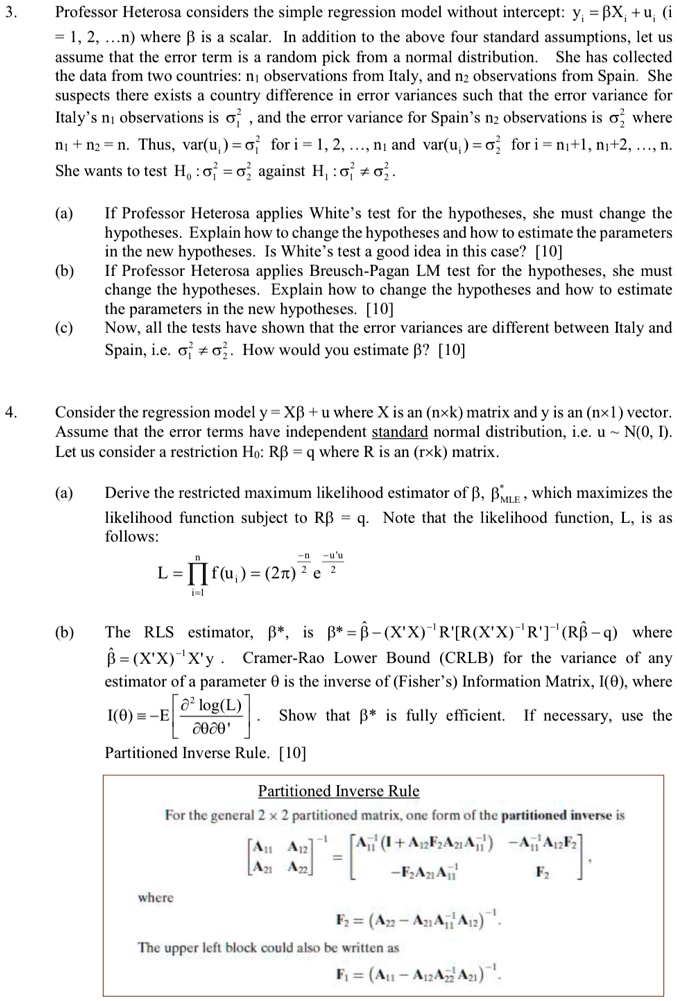
3. Professor Heterosa considers the simple regression model without intercept: $y_i = \beta X_i + u_i$ (i = 1, 2, ...n) where $\beta$ is a scalar. In addition to the above four standard assumptions, let us assume that the error term is a random pick from a normal distribution. She has collected the data from two countries: $n_1$ observations from Italy, and $n_2$ observations from Spain. She suspects there exists a country difference in error variances such that the error variance for Italy's $n_1$ observations is $\sigma_1^2$, and the error variance for Spain's $n_2$ observations is $\sigma_2^2$ where $n_1 + n_2 = n$. Thus, $var(u_i) = \sigma_1^2$ for i = 1, 2, ..., $n_1$ and $var(u_i) = \sigma_2^2$ for i = $n_1$+1, $n_1$+2, ..., n. She wants to test $H_0: \sigma_1^2 = \sigma_2^2$ against $H_1 : \sigma_1^2 \ne \sigma_2^2$. (a) If Professor Heterosa applies White's test for the hypotheses, she must change the hypotheses. Explain how to change the hypotheses and how to estimate the parameters in the new hypotheses. Is White's test a good idea in this case? [10] (b) If Professor Heterosa applies Breusch-Pagan LM test for the hypotheses, she must change the hypotheses. Explain how to change the hypotheses and how to estimate the parameters in the new hypotheses. [10] (c) Now, all the tests have shown that the error variances are different between Italy and Spain, i.e. $\sigma_1^2 \ne \sigma_2^2$. How would you estimate $\beta$? [10] 4. Consider the regression model $y = X\beta + u$ where X is an (n×k) matrix and y is an (n×1) vector. Assume that the error terms have independent standard normal distribution, i.e. $u \sim N(0, I)$. Let us consider a restriction $H_0: R\beta = q$ where R is an (rxk) matrix. (a) Derive the restricted maximum likelihood estimator of $\beta$, $\beta^{MLE}$, which maximizes the likelihood function subject to $R\beta = q$. Note that the likelihood function, L, is as follows: $L = \prod_{i=1}^n f(u_i) = (2\pi)^{-\frac{n}{2}} e^{-\frac{u'u}{2}}$ (b) The RLS estimator, $\beta^*$, is $\beta^* = \hat{\beta} - (X'X)^{-1}R'[R(X'X)^{-1}R']^{-1}(R\hat{\beta} - q)$ where $\hat{\beta} = (X'X)^{-1}X'y$. Cramer-Rao Lower Bound (CRLB) for the variance of any estimator of a parameter $\theta$ is the inverse of (Fisher's) Information Matrix, I($\theta$), where $I(\theta) = -E[\frac{\partial^2 log(L)}{\partial \theta \partial \theta'}]$. Show that $\beta^*$ is fully efficient. If necessary, use the Partitioned Inverse Rule. [10] Partitioned Inverse Rule. [10] For the general 2 × 2 partitioned matrix, one form of the partitioned inverse is $\begin{bmatrix} A_{11} & A_{12} \\ A_{21} & A_{22} \end{bmatrix}^{-1} = \begin{bmatrix} F_1(I + A_{12}F_2A_{21}F_1) & -A_{11}A_{12}F_2 \\ -F_2A_{21}A_{11} & F_2 \end{bmatrix}$ where $F_2 = (A_{22} - A_{21}A_{11}^{-1}A_{12})^{-1}$ The upper left block could also be written as $F_1 = (A_{11} - A_{12}A_{22}^{-1}A_{21})^{-1}$
View Answer
divider
BEST MATCH

Average fixed cost is defined as: A. total fixed cost divided by quantity. B. total variable cost divided by quantity. C. quantity divided by total variable cost. D. the change in total variable cost divided by the change in quantity.

View Answer
divider
BEST MATCH

The names of the employees of Hogan Thrift Shop are listed on the following payroll register. Employees are paid weekly. The marital status and the number of allowances claimed are shown on the payroll register, along with each employee's weekly salary, which has remained the same all year. Complete the payroll register for the payroll period ending December 20, 20--, the 51st weekly payday. The state income tax rate is 3.1% of total earnings, the city income tax rate is 1% of the total gross earnings, and the **wage-bracket method** is used for federal income taxes. Enter all amounts as positive numbers. Round your calculations and final answers to the nearest cent. As we go to press, the federal income tax rates for 2024 are being determined by budget talks in Washington, and are not available for publication. For this edition, the 2023 federal income tax tables for Manual Systems with Forms W-4 From 2020 or Later with Standard Withholding and 2023 FICA rates have been used. Click hi Chapter 4 PART III Problem Based Test assignment take frame Hogan Thrift Shop Payroll Register FOR PERIOD ENDING December 20, 20-- (a) FICA Filing No. of W/H Total (b) Employee Name Status Allowances Earnings OASDI HI FIT Gold, Ken MFJ N/A $1,900.00 $117.80 $27.55 Morton, Cam S N/A $690.00 $42.78 $9.98 Wendal, Hal MFJ N/A $675.00 $41.85 $9.79 Cox, Debbie S N/A $510.00 $31.62 $7.40 Hurley, Don S N/A $1,010.00 $62.62 $14.65 Hand, Cheryl S N/A $850.00 $52.7 $12.33 Welsh, Ronda S N/A $590.90 $36.63 $8.57 Ruiz, Stacy MFJ N/A $611.15 $37.85 $8.87 Totals $6,837.05 Compute the employer's FICA taxes for the pay period ending December 20, 20--. OASDI Taxes OASDI taxable earnings $ HI Taxes HI taxable earnings $ OASDI taxes $ HI taxes $ Deductions (c) SIT (d) CIT (e) Net Pay

View Answer
divider
BEST MATCH

Question 19 Which of the following statements about China's healthcare system is not true? The system is governed by the Fundamental Health Law and the Hygienic Common Law. Healthcare bills are sent to the National People's Congress or Standing Committee for review. It fell short of its target of public health insurance coverage for 90 percent of its population. It offers basic, urban-resident, rural cooperative, and medical assistance insurance programs. 0.25 pts

View Answer
divider
BEST MATCH

Use substitution to find the indefinite integral $\int (\sqrt[5]{t} + 8t)(5t^4 + 8)dt$. $\int (\sqrt[5]{t} + 8t)(5t^4 + 8)dt = $

View Answer
divider
BEST MATCH

Use the graph of f to find the value of f(6). f(6) =

View Answer
divider
BEST MATCH

Question 25 (4 points) Let $f(x) = x^2 - 8x$ and $g(x) = \begin{cases} x - 1, & x < -5 \ -x, & x \ge -5 \end{cases}$ Evaluate $(f/g)(7)$

View Answer
divider
BEST MATCH

According to Kepler's third law, the orbital period $T$ of a planet is related to the radius $R$ of its orbit by $T^2 \propto R^3$. Neptune's orbit is larger than Earth's by a factor of 30.05. What is Neptune's orbital period? (Earth's orbital period is 1 yr.)

View Answer
divider