Homework 4
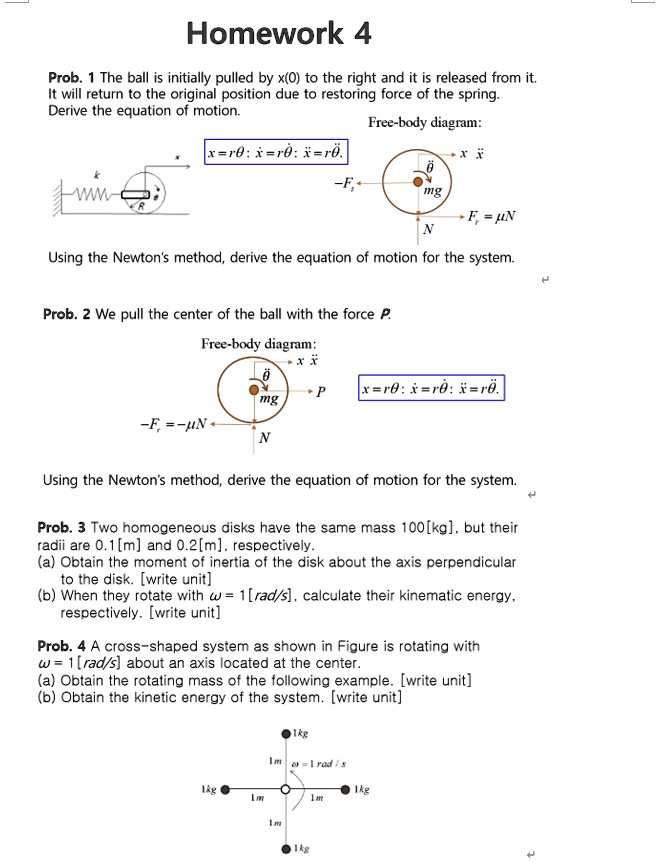
Prob. 1 The ball is initially pulled by x(0) to the right and it is released from it.
It will return to the original position due to restoring force of the spring.
Derive the equation of motion.
Free-body diagram:
x = r\dot{\theta}; \dot{x} = r\ddot{\theta}; \ddot{x} = r\dot{\theta}.
-F_r
mg
F_r = \mu N
N
Using the Newton's method, derive the equation of motion for the system.
Prob. 2 We pull the center of the ball with the force P.
Free-body diagram:
x = r\dot{\theta}; \dot{x} = r\ddot{\theta}; \ddot{x} = r\dot{\theta}.
mg
P
-F_r = -\mu N
N
Using the Newton's method, derive the equation of motion for the system.
Prob. 3 Two homogeneous disks have the same mass 100 [kg], but their
radii are 0.1 [m] and 0.2[m], respectively.
(a) Obtain the moment of inertia of the disk about the axis perpendicular
to the disk. [write unit]
(b) When they rotate with \omega = 1 [rad/s], calculate their kinematic energy.
respectively. [write unit]
Prob. 4 A cross-shaped system as shown in Figure is rotating with
\omega = 1 [rad/s] about an axis located at the center.
(a) Obtain the rotating mass of the following example. [write unit]
(b) Obtain the kinetic energy of the system. [write unit]
1kg
1m
\omega = 1 rad/s
1kg
1kg
1m
1m
1m
1kg