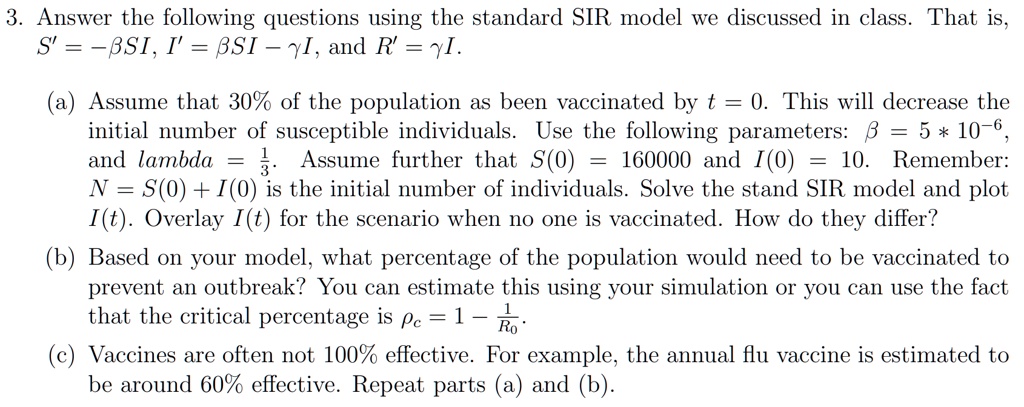
3. Answer the following questions using the standard SIR model we discussed in class. That is,
$S' = -\beta SI$, $I' = \beta SI - \gamma I$, and $R' = \gamma I$.
(a) Assume that 30% of the population as been vaccinated by $t = 0$. This will decrease the
initial number of susceptible individuals. Use the following parameters: $\beta = 5 * 10^{-6}$,
and $\lambda = \frac{1}{3}$. Assume further that $S(0) = 160000$ and $I(0) = 10$. Remember:
$N = S(0) + I(0)$ is the initial number of individuals. Solve the stand SIR model and plot
$I(t)$. Overlay $I(t)$ for the scenario when no one is vaccinated. How do they differ?
(b) Based on your model, what percentage of the population would need to be vaccinated to
prevent an outbreak? You can estimate this using your simulation or you can use the fact
that the critical percentage is $p_c = 1 - \frac{1}{R_0}$.
(c) Vaccines are often not 100% effective. For example, the annual flu vaccine is estimated to
be around 60% effective. Repeat parts (a) and (b).