Ace - AI Tutor
Ask Our Educators
Textbooks
My Library
Flashcards
Scribe - AI Notes
Notes & Exams
Download App
jose angel sanchez

jose angel s.

Divider

Questions asked

BEST MATCH

how this new knowledge has shaped your perceptions of women in criminal justice professions. Think about what most interested, surprised, or concerned you about what you learned? Does it align with any prior experience you have working in the field? How might you use what you learned in the future

View Answer
divider
BEST MATCH

P2. A component made of a steel alloy ($\nu$ = 0.30; E = 205 GPa) is loaded with a horizontal force P as shown. A strain rosette mounted at point A on the free surface provides the normal strain data as follows: $\epsilon_a$ = 150 $\mu$ mm/mm; $\epsilon_b$ = -90 $\mu$ mm/mm; $\epsilon_c$ = -400 $\mu$ mm/mm; Determine $\sigma_n$, $\sigma_t$, and $\tau_{nt}$ acting at point A (if $\theta$ = 55°).

View Answer
divider
BEST MATCH

2. [-/2 Points] DETAILS TANAPCALCBR10 3.5.005. Find the first and second derivatives of the function. h(t) = t^4 - 6t^3 + 9t^2 - 5t - 12 h'(t) = h"(t) =

View Answer
divider
BEST MATCH

Write matlab code for pathlines streaklines and streamlines for the following 2-d flow visualization equation \(\vec{V} = (\bar{u}, \bar{v}) = (1.2 + 0.4x)\hat{i} + (0.7 + 3.1sin(\omega t) - 0.8y)\hat{j}\) Where the angular velocity, \(\omega\) is equal to 3\(\pi\), 0 < x < 5 m, -1 m < y < 5 m and 0 < t < 3 s.

View Answer
divider
BEST MATCH

2. The linear system $\Sigma_1$ is given as $\dot{x}(t) = \begin{bmatrix} -2 & -5\\ 1 & a \end{bmatrix} x(t) + \begin{bmatrix} 1\\ 0 \end{bmatrix} u(t)$ $y(t) = \begin{bmatrix} 0 & 1 \end{bmatrix} x(t) + \begin{bmatrix} 0 \end{bmatrix} u(t)$ (a) Determine the values of the parameter $a$ for which the system $\Sigma_1$ is critically damped. (b) Find the natural frequency of the linear system $\Sigma_1$ in terms of the parameter $a$. (c) Determine the value of $a$ for which $y(t)$ is unbounded for $u(t) = 3\sin(t)$.

View Answer
divider
BEST MATCH

4 For each of the following, determine the limit. (a) $\lim_{x \to 1^{-}} \frac{x + 1}{x^2 - 1}$ (c) $\lim_{x \to \pi^{+}} \frac{1}{\sin x}$

View Answer
divider
BEST MATCH

For the following system of ODEs, solve for the phase paths. \(\dot{x} = x + y \) \(\dot{y} = 6x + 2y\)

View Answer
divider
BEST MATCH

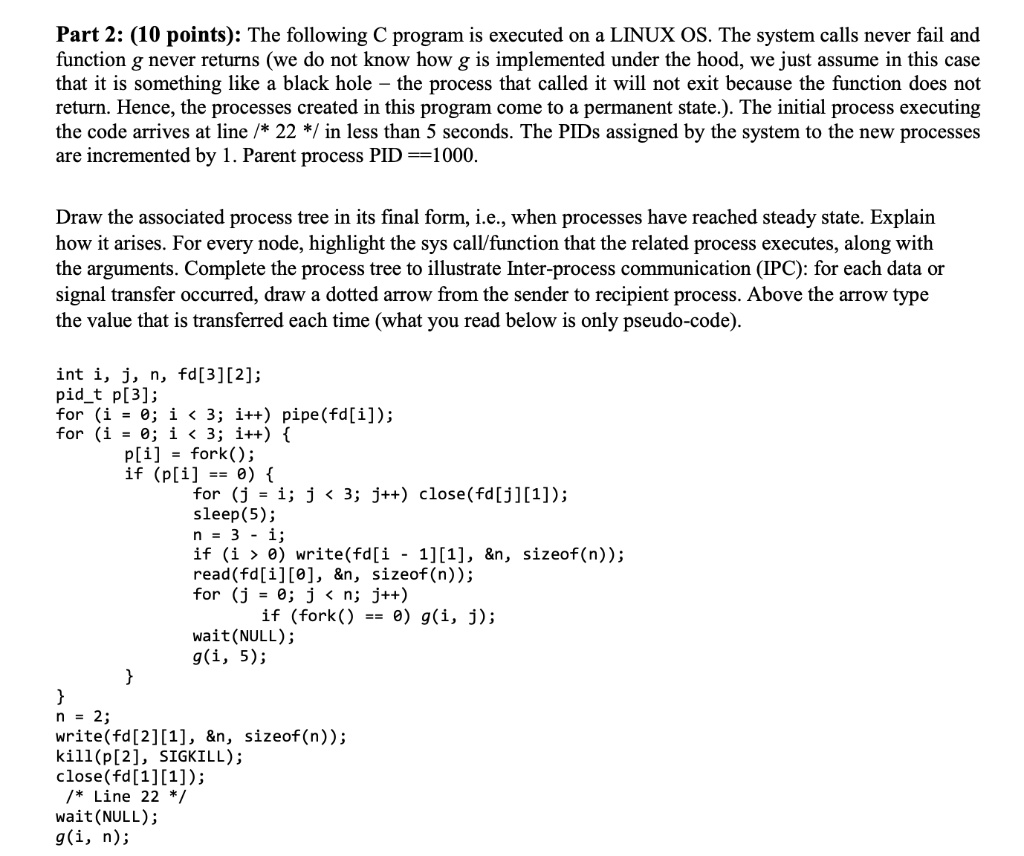
Part 2: (10 points): The following C program is executed on a LINUX OS. The system calls never fail and function g never returns (we do not know how g is implemented under the hood, we just assume in this case that it is something like a black hole — the process that called it will not exit because the function does not return. Hence, the processes created in this program come to a permanent state.). The initial process executing the code arrives at line /* 22 */ in less than 5 seconds. The PIDs assigned by the system to the new processes are incremented by 1. Parent process PID ==1000. Draw the associated process tree in its final form, i.e., when processes have reached steady state. Explain how it arises. For every node, highlight the sys call/function that the related process executes, along with the arguments. Complete the process tree to illustrate Inter-process communication (IPC): for each data or signal transfer occurred, draw a dotted arrow from the sender to recipient process. Above the arrow type the value that is transferred each time (what you read below is only pseudo-code). int i, j, n, fd[3][2]; pid_t p[3]; for (i = 0; i < 3; i++) pipe(fd[i]); for (i = 0; i < 3; i++) { p[i] = fork(); if (p[i] == 0) { for (j=i; j < 3; j++) close(fd[j][1]); sleep(5); n = 3 * i; if (i > 0) write(fd[i - 1][1], &n, sizeof(n)); read(fd[i][0], &n, sizeof(n)); for (j = 0; j < n; j++) if (fork() == 0) g(i, j); wait(NULL); g(i, 5); } } n = 2; write(fd[2][1], &n, sizeof(n)); kill(p[2], SIGKILL); close(fd[1][1]); /* Line 22 */ wait(NULL); g(i, n);
View Answer
divider
BEST MATCH

What is a virtue according to Aristotle? 1. A law of nature. 2. A rule that we use to guide our actions. 3. A divine command. 4. A midway point between two extremes.

View Answer
divider
BEST MATCH

1. TRUE or FALSE: "If you invest money for 10 years at 8% interest, compounded quarterly, you are effectively investing money for 40 three-month periods, during which you receive 4% interest each period." a. True b. False

View Answer
divider