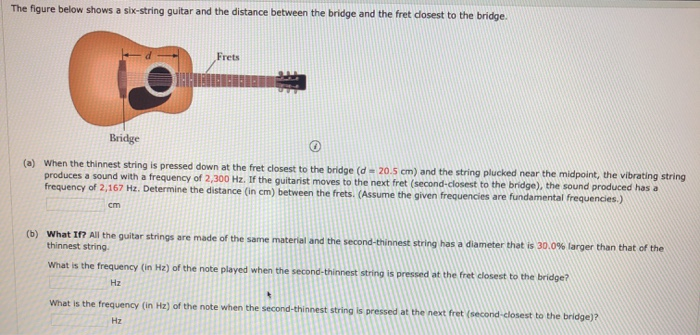
The figure below shows a six-string guitar and the distance between the bridge and the fret closest to the bridge.
(i)
(a) When the thinnest string is pressed down at the fret closest to the bridge ( \( d=20.5 \mathrm{~cm} \) ) and the string plucked near the midpoint, the vibrating string produces a sound with a frequency of \( 2,300 \mathrm{~Hz} \). If the guitarist moves to the next fret (second-closest to the bridge), the sound produced has a frequency of \( 2,167 \mathrm{~Hz} \). Determine the distance (in cm ) between the frets. (Assume the given frequencies are fundamental frequencies.)
\( \square \) cm
(b) What If All the guitar strings are made of the same material and the second-thinnest string has a diameter that is \( 30.0 \% \) larger than that of the thinnest string.
What is the frequency (in Hz ) of the note played when the second-thinnest string is pressed at the fret closest to the bridge?
Hz
What is the frequency (in Hz ) of the note when the second-thinnest string is pressed at the next fret (second-closest to the bridge)?
Hz