Question 2
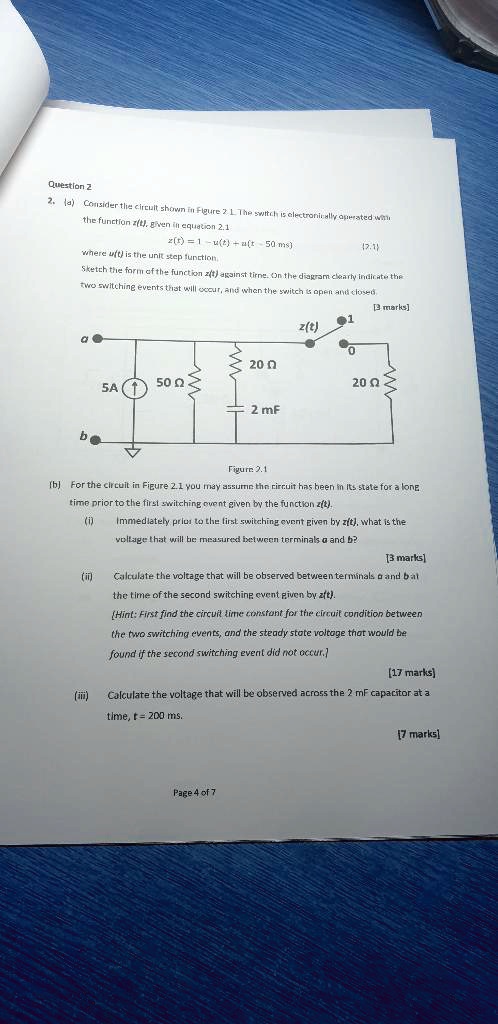
2. (a) Consider the circuit shown in Figure 2.1. The switch is electronically operated with
the function $z(t)$, given in equation 2.1
$z(t) = 1 - u(t) + u(t - 50 \text{ ms})$
(2.1)
where $u(t)$ is the unit step function.
Sketch the form of the function $z(t)$ against time. On the diagram clearly indicate the
two switching events that will occur, and when the switch is open and closed
[3 marks]
$z(t)$ 1
0
$5A$
$50 \Omega$
$20 \Omega$
$20 \Omega$
$2 \text{ mF}$
Figure 2.1
(b) For the circuit in Figure 2.1 you may assume the circuit has been in its state for a long
time prior to the first switching event given by the function $z(t)$.
(i) Immediately prior to the first switching event given by $z(t)$, what is the
voltage that will be measured between terminals a and b?
[3 marks]
(ii) Calculate the voltage that will be observed between terminals a and b at
the time of the second switching event given by $z(t)$.
(Hint: First find the circuit time constant for the circuit condition between
the two switching events, and the steady state voltage that would be
found if the second switching event did not occur.)
[17 marks]
(iii) Calculate the voltage that will be observed across the 2 mF capacitor at a
time, $t = 200 \text{ ms}$.
[7 marks]
Page 4 of 7