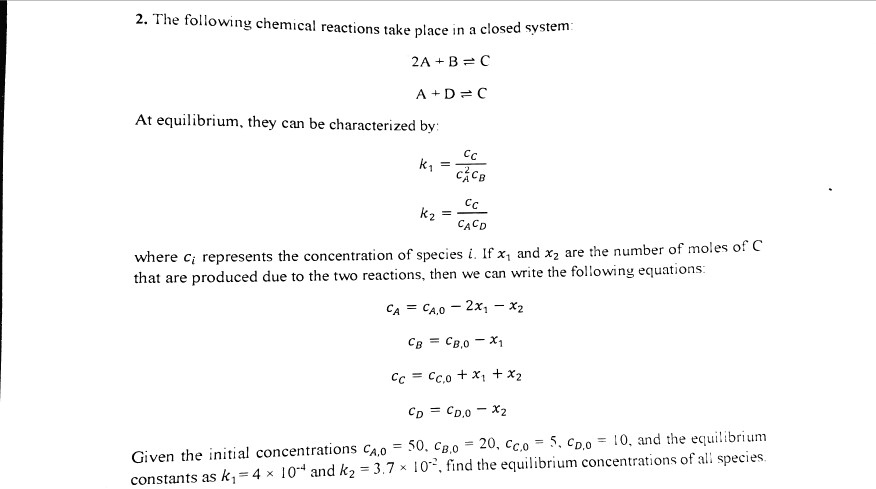
2. The following chemical reactions take place in a closed system:
2A + B = C
A + D = C
At equilibrium, they can be characterized by:
$k_1 = \frac{c_C}{c_A^2 c_B}$
$k_2 = \frac{c_C}{c_A c_D}$
where $c_i$ represents the concentration of species i. If $x_1$ and $x_2$ are the number of moles of C
that are produced due to the two reactions, then we can write the following equations:
$c_A = c_{A,0} - 2x_1 - x_2$
$c_B = c_{B,0} - x_1$
$c_C = c_{C,0} + x_1 + x_2$
$c_D = c_{D,0} - x_2$
Given the initial concentrations $c_{A,0} = 50$, $c_{B,0} = 20$, $c_{C,0} = 5$, $c_{D,0} = 10$, and the equilibrium
constants as $k_1 = 4 \times 10^{-4}$ and $k_2 = 3.7 \times 10^{-2}$, find the equilibrium concentrations of all species.