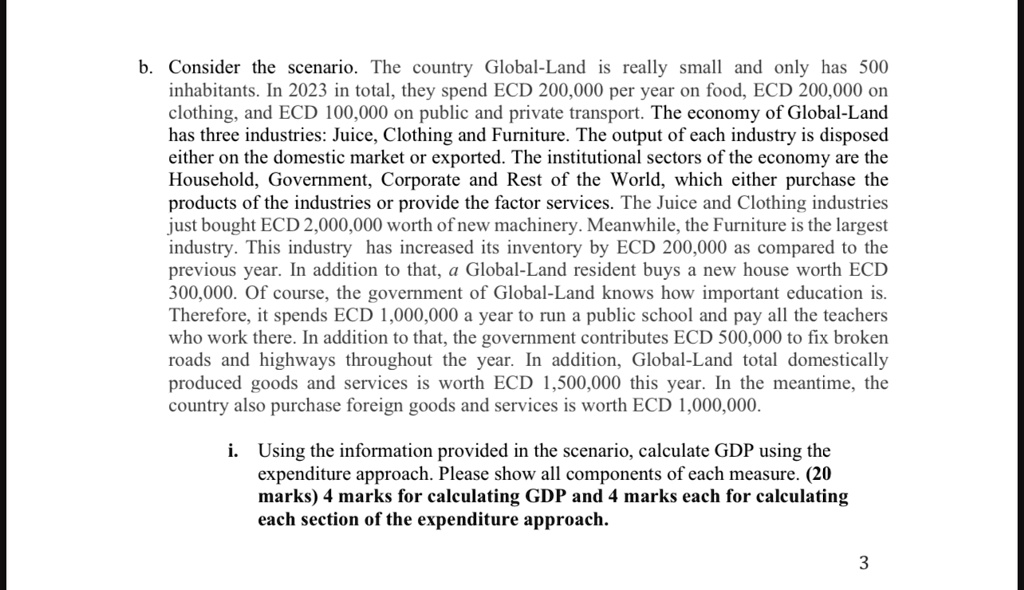
b. Consider the scenario. The country Global-Land is really small and only has 500 inhabitants. In 2023 in total, they spend ECD 200,000 per year on food, ECD 200,000 on clothing, and ECD 100,000 on public and private transport. The economy of Global-Land has three industries: Juice, Clothing and Furniture. The output of each industry is disposed either on the domestic market or exported. The institutional sectors of the economy are the Household, Government, Corporate and Rest of the World, which either purchase the products of the industries or provide the factor services. The Juice and Clothing industries just bought ECD 2,000,000 worth of new machinery. Meanwhile, the Furniture is the largest industry. This industry has increased its inventory by ECD 200,000 as compared to the previous year. In addition to that, a Global-Land resident buys a new house worth ECD 300,000. Of course, the government of Global-Land knows how important education is. Therefore, it spends ECD 1,000,000 a year to run a public school and pay all the teachers who work there. In addition to that, the government contributes ECD 500,000 to fix broken roads and highways throughout the year. In addition, Global-Land total domestically produced goods and services is worth ECD 1,500,000 this year. In the meantime, the country also purchase foreign goods and services is worth ECD 1,000,000.
i. Using the information provided in the scenario, calculate GDP using the expenditure approach. Please show all components of each measure. (20 marks) 4 marks for calculating GDP and 4 marks each for calculating each section of the expenditure approach.