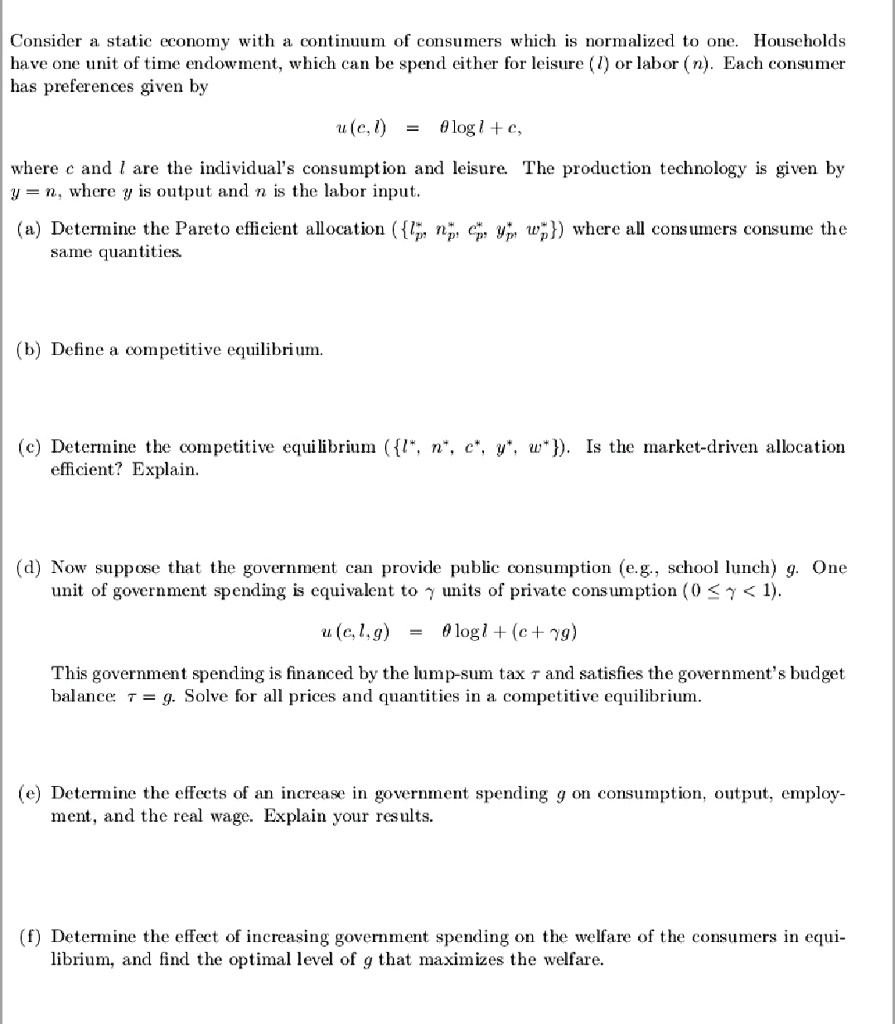
Consider a static economy with a continuum of consumers which is normalized to one. Households
have one unit of time endowment, which can be spend either for leisure ($l$) or labor ($n$). Each consumer
has preferences given by
$u(c, l) = \theta \log l + c$,
where $c$ and $l$ are the individual's consumption and leisure. The production technology is given by
$y = n$, where $y$ is output and $n$ is the labor input.
(a) Determine the Pareto efficient allocation ($\{l^*, n^*, c^*, y^*, w^*\}$) where all consumers consume the
same quantities.
(b) Define a competitive equilibrium.
(c) Determine the competitive equilibrium ($\{l^*, n^*, c^*, y^*, w^*\}$). Is the market-driven allocation
efficient? Explain.
(d) Now suppose that the government can provide public consumption (e.g., school lunch) $g$. One
unit of government spending is equivalent to $\gamma$ units of private consumption ($0 < \gamma < 1$).
$u(c, l, g) = \theta \log l + (c + \gamma g)$
This government spending is financed by the lump-sum tax $\tau$ and satisfies the government's budget
balance: $\tau = g$. Solve for all prices and quantities in a competitive equilibrium.
(e) Determine the effects of an increase in government spending $g$ on consumption, output, employ-
ment, and the real wage. Explain your results.
(f) Determine the effect of increasing government spending on the welfare of the consumers in equi-
librium, and find the optimal level of $g$ that maximizes the welfare.