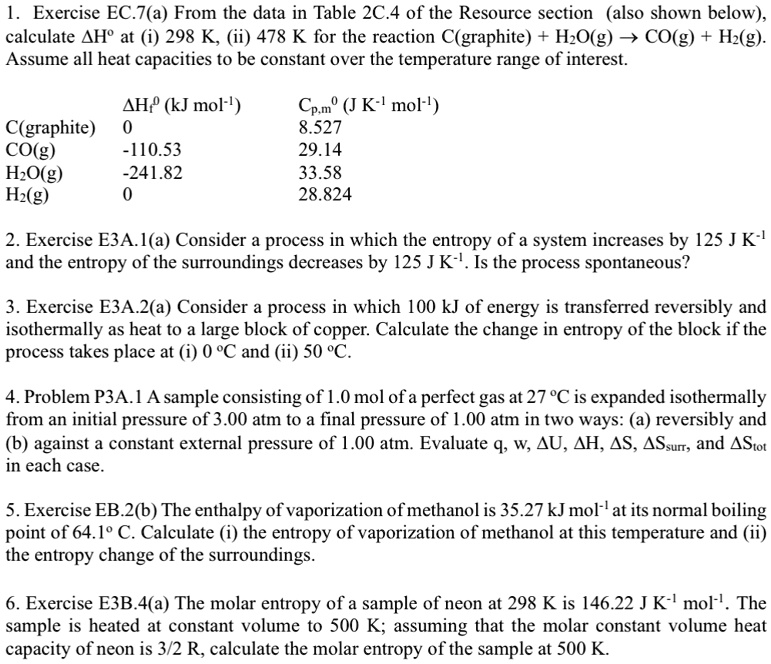
1. Exercise EC.7(a) From the data in Table 2C.4 of the Resource section (also shown below),
calculate ∆H° at (i) 298 K, (ii) 478 K for the reaction C(graphite) + H2O(g) → CO(g) + H2(g).
Assume all heat capacities to be constant over the temperature range of interest.
AH (kJ mol-¹)
Cp,m (J K-¹ mol-¹)
C(graphite)
0
8.527
CO(g)
-110.53
29.14
H2O(g)
-241.82
33.58
H2(g)
0
28.824
2. Exercise E3A.1(a) Consider a process in which the entropy of a system increases by 125 J K-1
and the entropy of the surroundings decreases by 125 J K-¹. Is the process spontaneous?
3. Exercise E3A.2(a) Consider a process in which 100 kJ of energy is transferred reversibly and
isothermally as heat to a large block of copper. Calculate the change in entropy of the block if the
process takes place at (i) 0 °C and (ii) 50 °C.
4. Problem P3A.1 A sample consisting of 1.0 mol of a perfect gas at 27 °C is expanded isothermally
from an initial pressure of 3.00 atm to a final pressure of 1.00 atm in two ways: (a) reversibly and
(b) against a constant external pressure of 1.00 atm. Evaluate q, w, AU, AH, AS, ASsurr, and AStot
in each case.
5. Exercise EB.2(b) The enthalpy of vaporization of methanol is 35.27 kJ mol-¹ at its normal boiling
point of 64.1° C. Calculate (i) the entropy of vaporization of methanol at this temperature and (ii)
the entropy change of the surroundings.
6. Exercise E3B.4(a) The molar entropy of a sample of neon at 298 K is 146.22 J K-¹ mol-¹. The
sample is heated at constant volume to 500 K; assuming that the molar constant volume heat
capacity of neon is 3/2 R, calculate the molar entropy of the sample at 500 K.