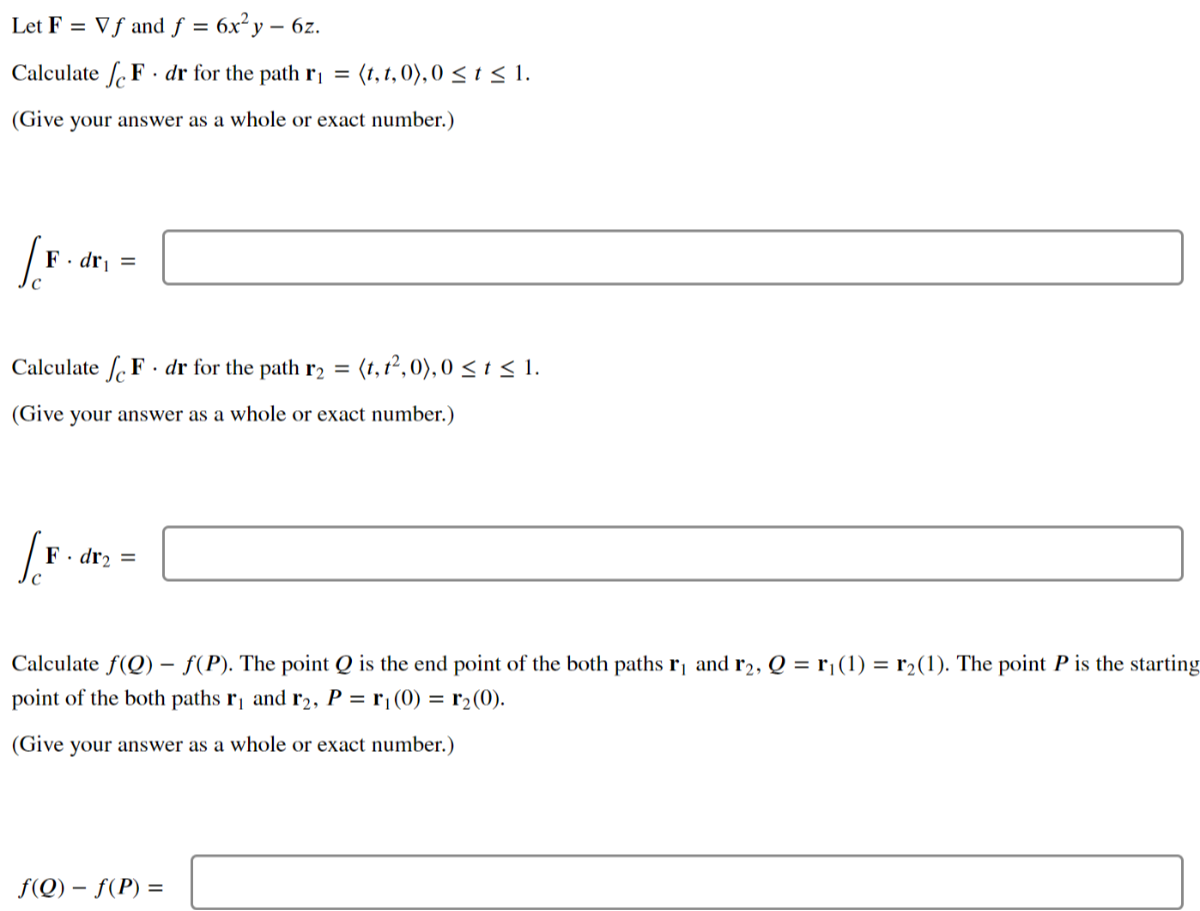
Let \( \mathbf{F}=\nabla f \) and \( f=6 x^{2} y-6 z \)
Calculate \( \int_{C} \mathbf{F} \cdot d \mathbf{r} \) for the path \( \mathbf{r}_{1}=\langle t, t, 0\rangle, 0 \leq t \leq 1 \).
(Give your answer as a whole or exact number.)
\[
\int_{\mathcal{C}} \mathbf{F} \cdot d \mathbf{r}_{1}=
\]
\( \square \)
Calculate \( \int_{C} \mathbf{F} \cdot d \mathbf{r} \) for the path \( \mathbf{r}_{2}=\left\langle t, t^{2}, 0\right\rangle, 0 \leq t \leq 1 \).
(Give your answer as a whole or exact number.)
\[
\int_{C} \mathbf{F} \cdot d \mathbf{r}_{2}=
\]
\( \square \)
Calculate \( f(Q)-f(P) \). The point \( Q \) is the end point of the both paths \( \mathbf{r}_{1} \) and \( \mathbf{r}_{2}, Q=\mathbf{r}_{1}(1)=\mathbf{r}_{2}(1) \). The point \( P \) is the starting point of the both paths \( \mathbf{r}_{1} \) and \( \mathbf{r}_{2}, P=\mathbf{r}_{1}(0)=\mathbf{r}_{2}(0) \).
(Give your answer as a whole or exact number.)
\[
f(Q)-f(P)=
\]
\( \square \)