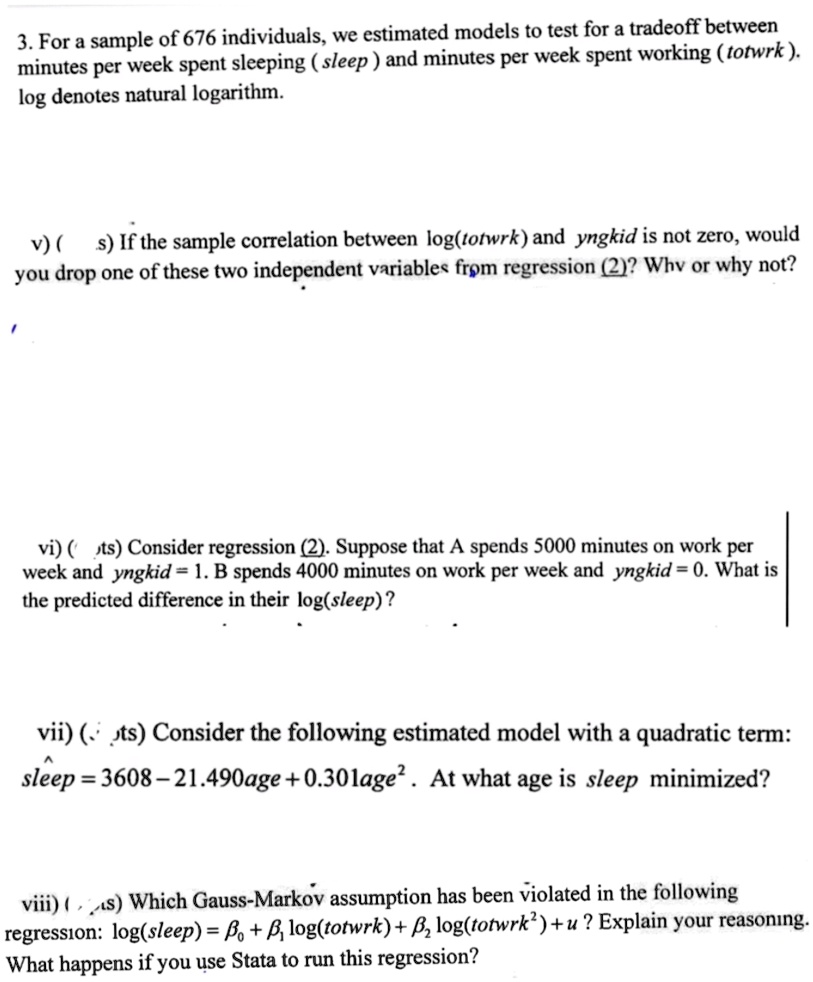
3. For a sample of 676 individuals, we estimated models to test for a tradeoff between
minutes per week spent sleeping \textit{(sleep)} and minutes per week spent working \textit{(totwrk)}.
\textit{log} denotes natural logarithm.
v) (s) If the sample correlation between \textit{log(totwrk)} and \textit{yngkid} is not zero, would
you drop one of these two independent variables from regression (2)? Whv or why not?
vi) (ts) Consider regression (2). Suppose that A spends 5000 minutes on work per
week and \textit{yngkid} = 1. B spends 4000 minutes on work per week and \textit{yngkid} = 0. What is
the predicted difference in their \textit{log(sleep)}?
vii) (ts) Consider the following estimated model with a quadratic term:
$\hat{\text{sleep}} = 3608 - 21.490\text{age} + 0.301\text{age}^2$. At what age is sleep minimized?
viii) (As) Which Gauss-Markov assumption has been violated in the following
regression: $\log(\text{sleep}) = \beta_0 + \beta_1 \log(\text{totwrk}) + \beta_2 \log(\text{totwrk}^2) + u$? Explain your reasoning.
What happens if you use Stata to run this regression?