10. The consumer price index, or CPI, measures the
cost of living for a typical urban household by
multiplying the price for each category of
expenditure (housing, food, and so on) times a
measure of the importance of that expenditure in
the average consumer's market basket and
summing over all categories. However, using data
from the CPI, we can see that changes in the cost
of living for different types of consumers can vary
a great deal. Let's compare the cost of living for a
hypothetical retired person and a hypothetical
university student. Let's assume that the market
basket of a retired person is allocated in the
following way: 10% on housing, 15% on food, 5%
on transportation, 60% on medical care, 0% on
education, and 10% on recreation. The university
student's market basket is allocated as follows: 5%
on housing, 15% on food, 20% on transportation,
0% on medical care, 40% on education, and 20% on
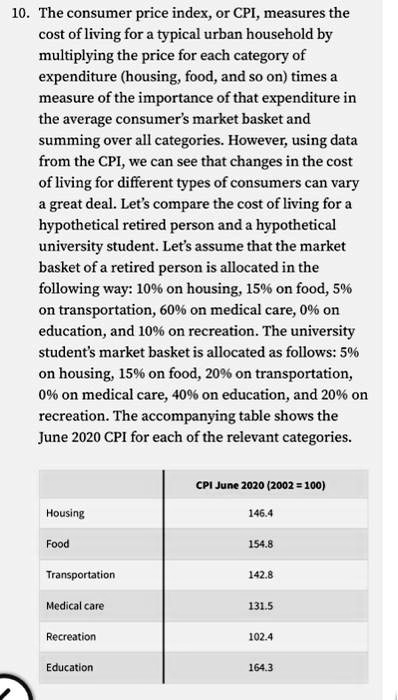
recreation. The accompanying table shows the
June 2020 CPI for each of the relevant categories.
CPI June 2020 (2002 = 100)
Housing
146.4
Food
154.8
Transportation
142.8
Medical care
131.5
Recreation
102.4
Education
164.3