BIO 340 Activity # 3: Trihybrid crosses, probability, and bedigrees
Name (Last, First): q,
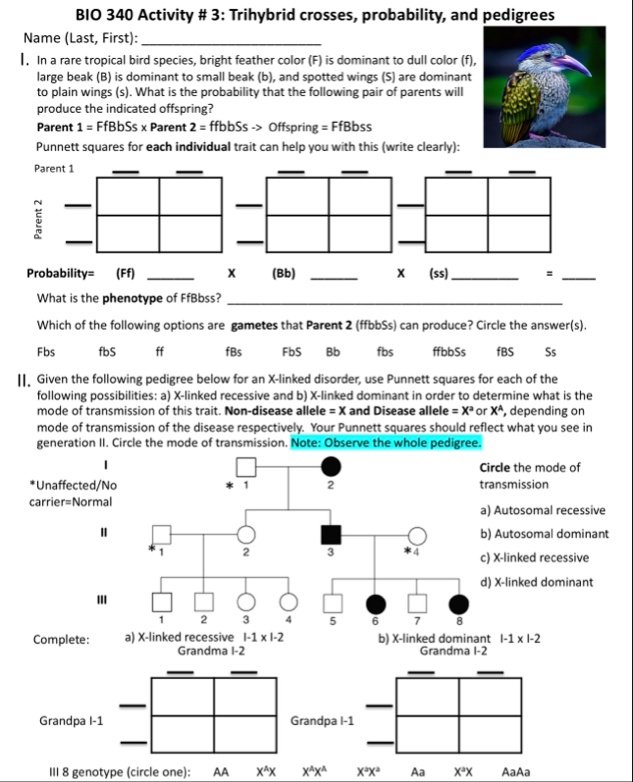
I. In a rare tropical bird species, bright feather color (F) is dominant to dull color (f), large beak (B) is dominant to small beak (b), and spotted wings (S) are dominant to plain wings (s). What is the probability that the following pair of parents will produce the indicated offspring?
Parent 1= FfBbSs \times Parent 2= ffbbSs -> Offspring = FfBbss
Punnett squares for each individual trait can help you with this (write clearly):
vvitat is the prenturye on riduss: q,
Which of the following options are gametes that Parent 2 (ffbbss) can produce? Circle the answer(s).
Fbs fbS ff fBs FbS Bb fbs ffbbs fBS Ss
II. Given the following pedigree below for an x-linked disorder, use Punnett squares for each of the following possibilities: a) x-linked recessive and b) x-linked dominant in order to determine what is the mode of transmission of this trait. Non-disease allele =x and Disease allele =x^(a) or x^(A), depending on mode of transmission of the disease respectively. Your Punnett squares should reflect what you see in generation II. Circle the mode of transmission. Note: Observe the whole pedigree.
\table[[I,de the mode of nsmission Autosomal recessive],[*Unaffected/No carrier=Normal,,,,,],[,,,,],[\table[[II],[III]],Autosomal dominant],[(-linked recessive],[k-linked dominant],[],[Complete:,a) X-linked recessive 1-1\times 1-2 Grandma I-2,,b) X-linked dominant I-1(x)/(x)I -2 Grandma I-2],[◻,\table[[q,