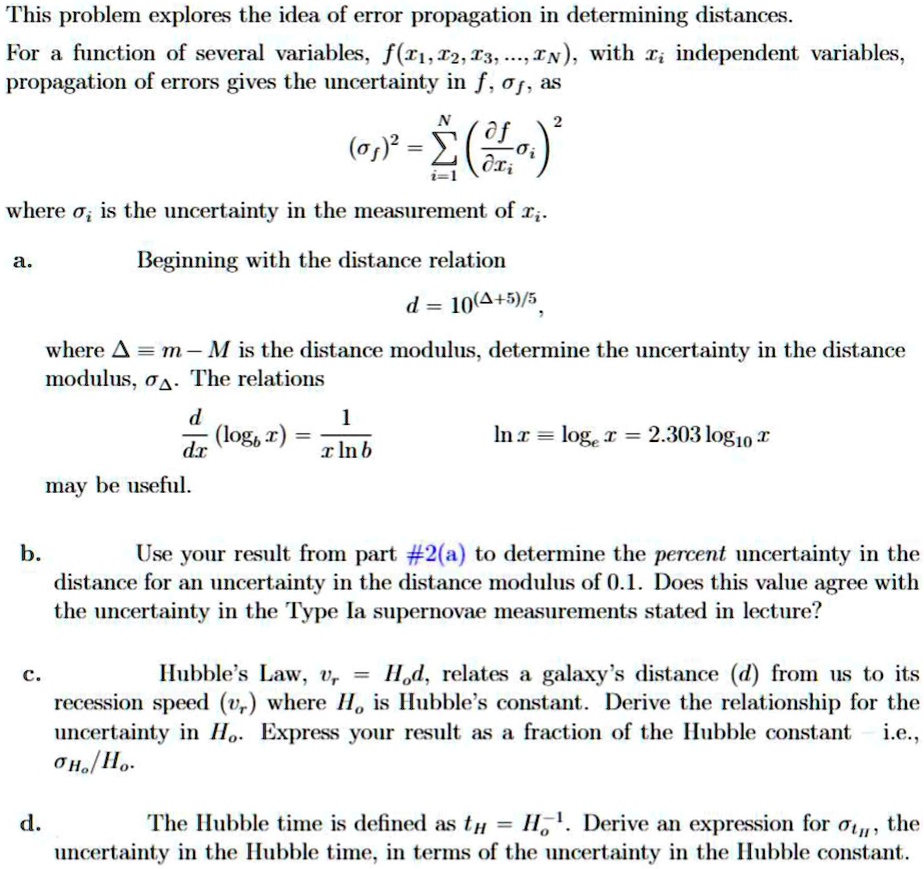
This problem explores the idea of error propagation in determining distances.
For a function of several variables, f(x_(1),x_(2),x_(3),dots,x_(N)), with x_(i) independent variables,
propagation of errors gives the uncertainty in f,sigma _(f), as
(sigma _(f))^(2)=sum_(i=1)^N ((delf)/(delx_(i))sigma _(i))^(2)
where sigma _(i) is the uncertainty in the measurement of x_(i).
a. Beginning with the distance relation
d=10^((Delta +5)/(5)),
where Delta -=m-M is the distance modulus, determine the uncertainty in the distance
modulus, sigma _(Delta ). The relations
(d)/(dx)(log_(b)x)=(1)/(xlnb),lnx-=log_(e)x=2.303log_(10)x
may be useful.
b. Use your result from part #2(a) to determine the percent uncertainty in the
distance for an uncertainty in the distance modulus of 0.1 . Does this value agree with
the uncertainty in the Type Ia supernovae measurements stated in lecture?
c.
Hubble's Law, v_(r)=H_(o)d, relates a galaxy's distance (d) from us to its
recession speed (v_(r)) where H_(o) is Hubble's constant. Derive the relationship for the
uncertainty in H_(o). Express your result as a fraction of the Hubble constant i.e.,
(sigma _(H_(o)))/(H_(o)).
d.
The Hubble time is defined as t_(H)=H_(o)^(-1). Derive an expression for sigma _(t_(H)), the
uncertainty in the Hubble time, in terms of the uncertainty in the Hubble constant.
This problem explores the idea of error propagation in determining distances
For a function of several variables, f(,2,3.,with independent variables propagation of errors gives the uncertainty in f, f, as
N
(of OT;
where o; is the uncertainty in the measurement of .
a.
Beginning with the distance relation d=10+5/5
where =m-M is the distance modulus.determine the uncertainty in the distance modulus,.The relations
P
1
lnx= loge=2.303 log1o
dx
lnb
may be useful.
b. Use your result from part #2(a to determine the percent uncertainty in the distance for an uncertainty in the distance modulus of O.l. Does this value agree with the uncertainty in the Type Ia supernovae measurements stated in lecture?
C. Hubbles Law, , = H.d, relates a galaxy's distance d from us to its recession speed (, where H. is Hubble's constant. Derive the relationship for the uncertainty in Ho. Express your result as a fraction of the Hubble constant -i.e., OH./Ho.
d. The Hubble time is defined as t = H-.Derive an expression for otuthe uncertainty in the Hubble time, in terms of the uncertainty in the Hubble constant.