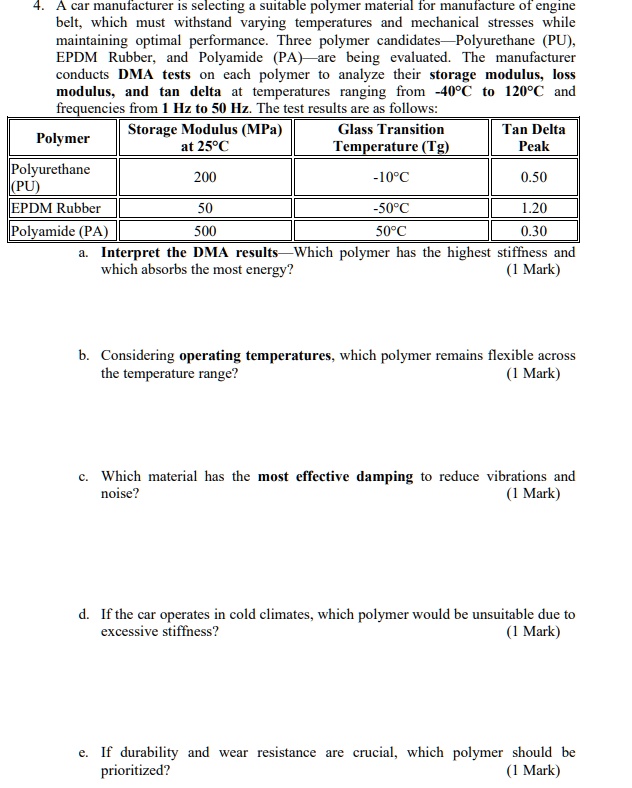
4. A car manufacturer is selecting a suitable polymer material for manufacture of engine belt, which must withstand varying temperatures and mechanical stresses while maintaining optimal performance. Three polymer candidates—Polyurethane (PU), EPDM Rubber, and Polyamide (PA)—are being evaluated. The manufacturer conducts DMA tests on each polymer to analyze their storage modulus, loss modulus, and tan delta at temperatures ranging from $-40^\circ C$ to $120^\circ C$ and frequencies from $1 Hz$ to $50 Hz$. The test results are as follows:
Polymer
Storage Modulus (MPa) at $25^\circ C$
Glass Transition Temperature (Tg)
Tan Delta Peak
Polyurethane (PU)
200
$-10^\circ C$
0.50
EPDM Rubber
50
$-50^\circ C$
1.20
Polyamide (PA)
500
$50^\circ C$
0.30
a. Interpret the DMA results—Which polymer has the highest stiffness and which absorbs the most energy?
(1 Mark)
b. Considering operating temperatures, which polymer remains flexible across the temperature range?
(1 Mark)
c. Which material has the most effective damping to reduce vibrations and noise?
(1 Mark)
d. If the car operates in cold climates, which polymer would be unsuitable due to excessive stiffness?
(1 Mark)
e. If durability and wear resistance are crucial, which polymer should be prioritized?
(1 Mark)