Ace - AI Tutor
Ask Our Educators
Textbooks
My Library
Flashcards
Scribe - AI Notes
Notes & Exams
Download App
jose luis luna

jose luis l.

Divider

Questions asked

BEST MATCH

PHYS 2B W25 - Week 8 Discussion 1. A bat locates insects by emitting ultrasonic "chirps" and then listening for echoes from the bugs. Suppose a bat chirp has a frequency of 25 kHz. How fast would the bat have to fly, and in what direction, for you to just barely be able to hear the chirp at 20 kHz?

View Answer
divider
BEST MATCH

All of the following are haploid cells EXCEPT one - which one is diploid? Select one: a. gametophytes b. mammalian gametes c. sperm d. sporophytes e. human egg cells

View Answer
divider
BEST MATCH

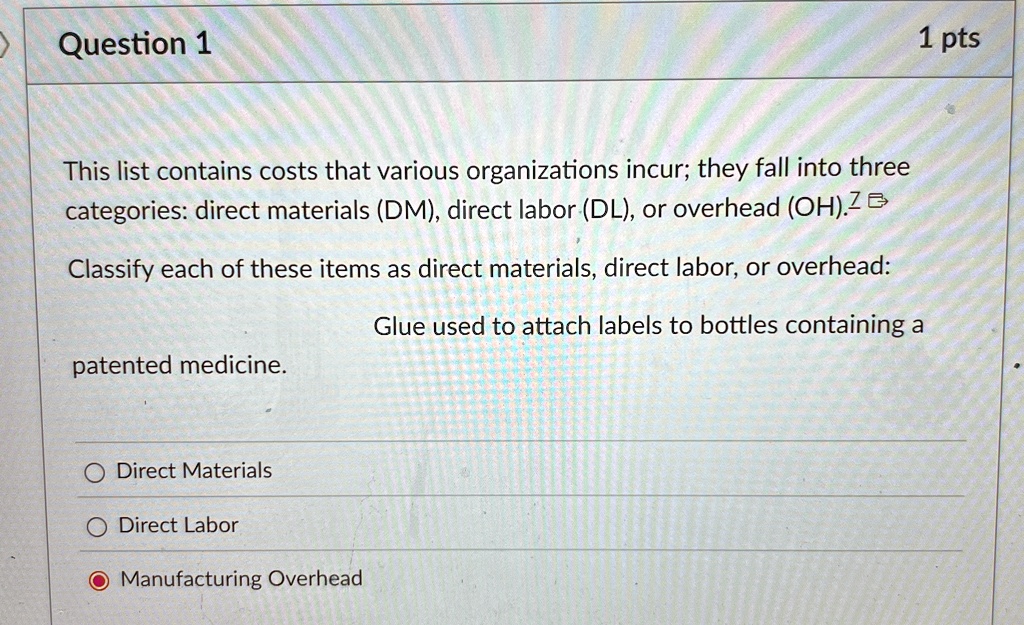
Question 1 1 pts This list contains costs that various organizations incur; they fall into three categories: direct materials (DM), direct labor (DL), or overhead (OH). Classify each of these items as direct materials, direct labor, or overhead: Glue used to attach labels to bottles containing a patented medicine. Direct Materials Direct Labor Manufacturing Overhead
View Answer
divider
BEST MATCH

A ball is thrown vertically into the air. Because of air resistence, its speed when it returns to its starting level compared to its initial speed

View Answer
divider
BEST MATCH

Choose the correct response for the largest lymphoid organ in the body. A adenoids B thymus C spleen D tonsils

View Answer
divider
BEST MATCH

Which of the types of receptors listed below is primarily used for detecting light rays under bright light conditions? amacrine cells rods olfactory hair cells cones ganglion neurons

View Answer
divider
BEST MATCH

How can mechanical engineers contribute to the improvement of water conservation and management practices through the design and optimization of irrigation systems, water treatment plants, and distribution networks?

View Answer
divider
BEST MATCH

6. An electric field is Find: $E(x, t) = 10 \cos(2\pi x - 3 \times 10^8 t) \text{ V/m}$ a) The amplitude of the field. b) The frequency of the wave. c) The wavelength of the wave. d) The wavenumber. e) The angular frequency. f) The wave velocity.

View Answer
divider
BEST MATCH

Identify the type/color for each star: (3pts) \begin{tabular}{|c|c|c|} \hline STAR & COLOR & TYPE \\ \hline Star A & & \\ \hline Star B & & \\ \hline Star C & & \\ \hline Star D & & \\ \hline \end{tabular} 4. How is the color of a star related to its temperature? 5. Explain why a cooler star could appear brighter than a hotter star.

View Answer
divider
BEST MATCH

Find the area and perimeter of the shaded areas of the figures below 1. A= P= Find the area and perimeter of the shaded areas of the figures below 1 A P 31

View Answer
divider