Ace - AI Tutor
Ask Our Educators
Textbooks
My Library
Flashcards
Scribe - AI Notes
Notes & Exams
Download App
jose manuel dickson

jose manuel d.

Divider

Questions asked

BEST MATCH

Why is it that the usual Lotka-Volterra competition equations are not adequate to explain (or model) predator-prey relationships?

View Answer
divider
BEST MATCH

Factorise each of the following \[ 27 y^{3}+125 z^{3} \]

View Answer
divider
BEST MATCH

A(n) ____ is an example of soft technology. Select one: image sensor radio-frequency identification tag database system bar-code scanner

View Answer
divider
BEST MATCH

The price for a product at which the quantity demanded and quantity supplied are equal is the market price supply/demand parity point cost-effective point equilibrium price The price for a product at which the quantity demanded and quantity supplied are equal is the O.market price O supply/demand parity point O cost-effective point O equilibrium price

View Answer
divider
BEST MATCH

QUESTION 3 A general solution of the linear homogeneous system X' = AX using the matrix exponential is given by

View Answer
divider
BEST MATCH

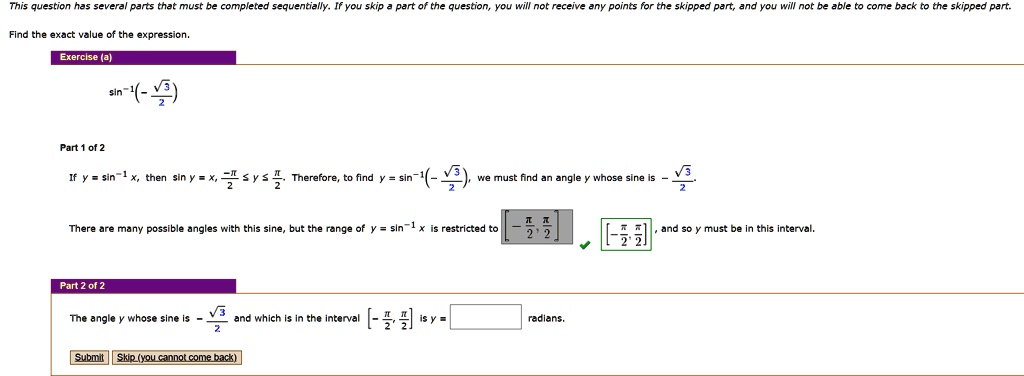
This question has several parts that must be completed sequentially. If you skip a part of the question, you will not receive any points for the skipped part, and you will not be able to come back to the skipped part. Find the exact value of the expression. Exercise (a) $\sin^{-1}(\frac{-\sqrt{3}}{2})$ Part 1 of 2 If $y = \sin^{-1}x$, then $\sin y = x$, $-\frac{\pi}{2} \le y \le \frac{\pi}{2}$. Therefore, to find $y = \sin^{-1}(\frac{-\sqrt{3}}{2})$, we must find an angle $y$ whose sine is $-\frac{\sqrt{3}}{2}$. There are many possible angles with this sine, but the range of $y = \sin^{-1}x$ is restricted to $[\frac{-\pi}{2}, \frac{\pi}{2}]$, and so $y$ must be in this interval. Part 2 of 2 The angle $y$ whose sine is $-\frac{\sqrt{3}}{2}$ and which is in the interval $[\frac{-\pi}{2}, \frac{\pi}{2}]$ is $y = $ radians. Submit Skip (you cannot come back)
View Answer
divider
BEST MATCH

Q1) Let the input to the system shown in Fig Q1, to be $x(t) = 4 + 12 \cos^2(\pi f_0 t) + 8 \sin(2\pi f_0 t) + 10 \sin(4\pi f_0 t)$, and the transfer function $\begin{cases} 1/5 & -1.5f_0 < f < 1.5f_0 \\ 0 & \text{otherwise} \end{cases}$ $H(f) =$ x(t) y(t) h(t) Fig Q1 a) Find and Plot the frequency spectra (amplitude & phase) for the input and the output. b) Find and plot the power spectral density for the input $G_i(f)$, and the output $G_o(f)$. c) Find the normalized input power $S_i$, and the normalized output power $S_o$. d) Find the power gain in dB.

View Answer
divider
BEST MATCH

write C++ Program This will result in a 3-bit shift register that can divide (shift right) or multiply (shift left) a 3-bit number by 2. the Output:( example) input 3 bit number: 111 choice( divide (shift right) or multiply (shift left) ): if user choice divide the output = 011 if user choice multiply the output = 110 use Bitwise operator shift right & shift left

View Answer
divider
BEST MATCH

2. (a) In Diagram 8, O is the centre of the quadrant of a circle with a radius of 14 cm. 14 cm 14 cm P T Diagram 8 Calculate the area of the shaded region. [Take $\pi = \frac{22}{7}$]

View Answer
divider
BEST MATCH

Using the given graph of the function f, find the following. (a) the intercepts, if any (b) its domain and range (c) the intervals on which it is increasing, decreasing, or constant (d) whether it is even, odd, or neither

View Answer
divider