PART 2: Coulomb Pendulum
1. Run the ejs_em_CoulombPendulum.jar java applet simulation. Close the Description for CoulombPendulum window and enlarge the Coulomb Pendulum window. Familiarise yourself with the controls - use the play \( \nabla \) button to start the simulation and the \( v=a \) button to slow the vibration down to a stop. In this simulation, the mass \( m \) of each particle are the same, the length / of the strings suspending the particles are each 1 m , the charge is given in \( \mu \mathrm{C}\left(10^{-6} \mathrm{C}\right) \) and the angle (from the vertical) is in degrees.
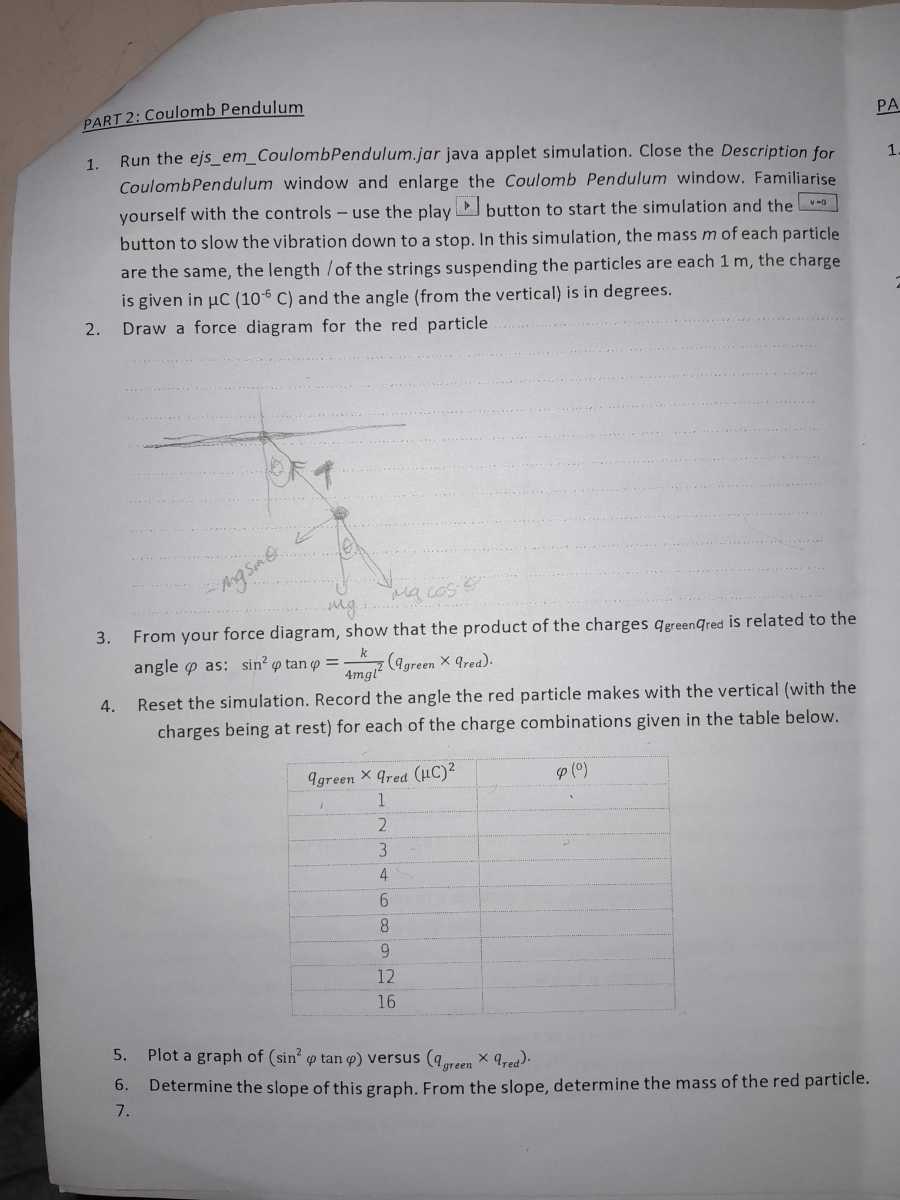
2. Draw a force diagram for the red particle
3. From your force diagram, show that the product of the charges \( q_{\text {green }} q_{\text {red }} \) is related to the angle \( \varphi \) as: \( \sin ^{2} \varphi \tan \varphi=\frac{k}{4 m g l^{2}}\left(q_{\text {green }} \times q_{\text {red }}\right) \).
4. Reset the simulation. Record the angle the red particle makes with the vertical (with the charges being at rest) for each of the charge combinations given in the table below.
\begin{tabular}{|c|c|}
\hline\( q_{\text {green }} \times q_{\text {red }}(\mu \mathrm{C})^{2} \) & \( \varphi\left({ }^{\circ}\right) \) \\
\hline 1 & \\
\hline 2 & \\
\hline 3 & \\
\hline 4 & \\
\hline 6 & \\
\hline 8 & \\
\hline 9 & \\
\hline 12 & \\
\hline 16 & \\
\hline
\end{tabular}
5. Plot a graph of \( \left(\sin ^{2} \varphi \tan \varphi\right) \) versus \( \left(q_{\text {green }} \times q_{\text {red }}\right) \).
6. Determine the slope of this graph. From the slope, determine the mass of the red particle.
7.