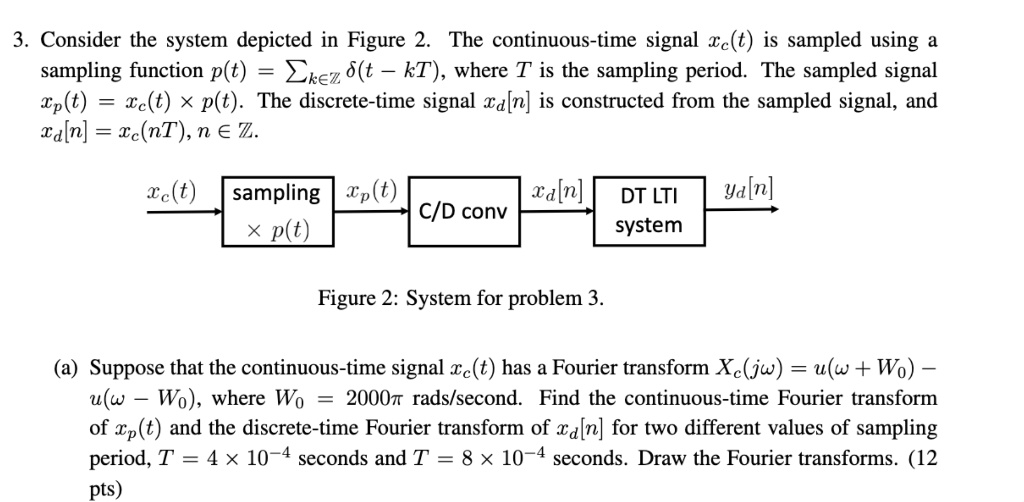
Consider the system depicted in Figure 2. The continuous-time signal c(t) is sampled using a sampling function p(t) = Ekez &(t - kT), where T is the sampling period. The sampled signal xp(t) = xc(t) * p(t). The discrete-time signal xa[n] is constructed from the sampled signal, and xa[n] = xc(nT), n ∈ Z.
Figure 2: System for problem 3.
(a) Suppose that the continuous-time signal c(t) has a Fourier transform Xc(jw) = u(w + Wo) - u(w - Wo), where Wo = 2000T rads/second. Find the continuous-time Fourier transform of xp(t) and the discrete-time Fourier transform of xa[n] for two different values of the sampling period, T = 4 * 10^(-4) seconds and T = 8 * 10^(-4) seconds. Draw the Fourier transforms. (12 pts)