Problem 5
Circulation is defined as
$\Gamma = \oint_C \mathbf{u} \cdot d\mathbf{s} = \iint_A \mathbf{\omega} \cdot \mathbf{\hat{n}} dA$,
where $C$ is a contour around area $A$, $\mathbf{u}$ is the velocity, $\mathbf{\omega}$ is the vorticity, $\hat{\mathbf{s}}$ is a unit vector along
the contour, $\mathbf{\hat{n}}$ is the unit normal to the area. Circulation is a measure of the rotation of a fluid
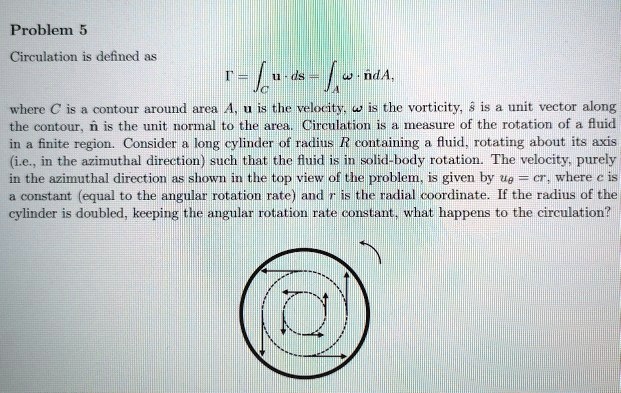
in a finite region. Consider a long cylinder of radius $R$ containing a fluid, rotating about its axis
(i.e., in the azimuthal direction) such that the fluid is in solid-body rotation. The velocity, purely
in the azimuthal direction as shown in the top view of the problem, is given by $u_\theta = cr$, where $c$ is
a constant (equal to the angular rotation rate) and $r$ is the radial coordinate. If the radius of the
cylinder is doubled, keeping the angular rotation rate constant, what happens to the circulation?