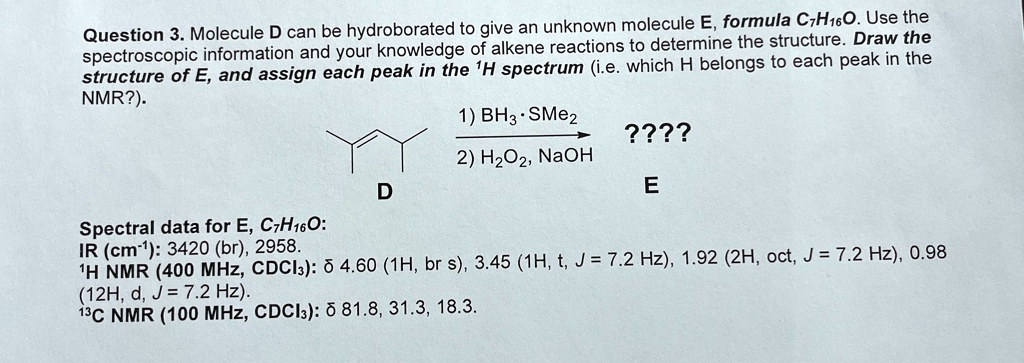
Question 3. Molecule D can be hydroborated to give an unknown molecule E, formula $C_7H_{16}O$. Use the spectroscopic information and your knowledge of alkene reactions to determine the structure. Draw the structure of E, and assign each peak in the $^1H$ spectrum (i.e. which H belongs to each peak in the NMR?).
1) $BH_3 \cdot SMe_2$
2) $H_2O_2$, NaOH
Spectral data for E, $C_7H_{16}O$:
IR ($cm^{-1}$): 3420 (br), 2958.
$^1H$ NMR (400 MHz, $CDCl_3$): $\delta$ 4.60 (1H, br s), 3.45 (1H, t, J = 7.2 Hz), 1.92 (2H, oct, J = 7.2 Hz), 0.98 (12H, d, J = 7.2 Hz).
$^{13}C$ NMR (100 MHz, $CDCl_3$): $\delta$ 81.8, 31.3, 18.3.