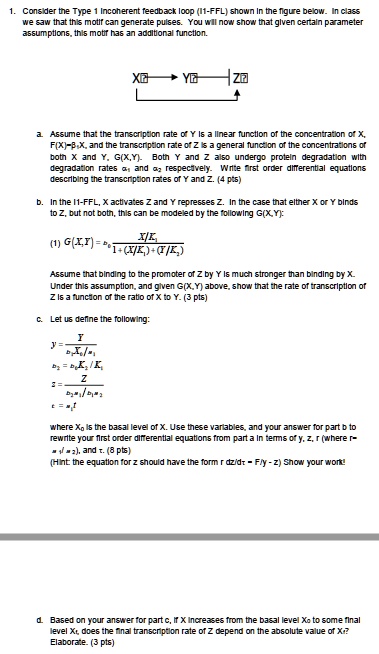
1. Consider the Type 1 Incoherent feedback loop (11-FFL) shown in the figure below. In class
we saw that this motif can generate pulses. You will now show that given certain parameter
assumptions, this motif has an additional function.
XY
Z
a. Assume that the transcription rate of Y is a linear function of the concentration of X,
F(X)=B?X, and the transcription rate of Z is a general function of the concentrations of
both X and Y, G(X,Y). Both Y and Z also undergo protein degradation with
degradation rates $\alpha_1$ and $\alpha_2$ respectively. Write first order differential equations
describing the transcription rates of Y and Z. (4 pts)
b. In the 11-FFL, X activates Z and Y represses Z. In the case that either X or Y binds
to Z, but not both, this can be modeled by the following G(X,Y):
$\frac{X/K_1}{1+(X/K_1)+(Y/K_2)}$
Assume that binding to the promoter of Z by Y is much stronger than binding by X.
Under this assumption, and given G(X,Y) above, show that the rate of transcription of
Z is a function of the ratio of X to Y. (3 pts)
c. Let us define the following:
y = $\frac{Y}{X_0/\alpha_1}$,
b? = $\frac{b_1K_2}{K_1}$
z = $\frac{Z}{X_0/\alpha_2}$
c = $\frac{\alpha_1}{\alpha_2}$
where $X_0$ is the basal level of X. Use these variables, and your answer for part b to
rewrite your first order differential equations from part a in terms of y, z, r (where r = $\frac{\alpha_1}{\alpha_2}$), and $\tau$. (8 pts)
(Hint: the equation for z should have the form r $\frac{dz}{dt}$ = F(y) - z) Show your work!
d. Based on your answer for part c, If X Increases from the basal level $X_0$ to some final
level $X_t$, does the final transcription rate of Z depend on the absolute value of $X_t$?
Elaborate. (3 pts)