Externalities - End of Chapter Problem
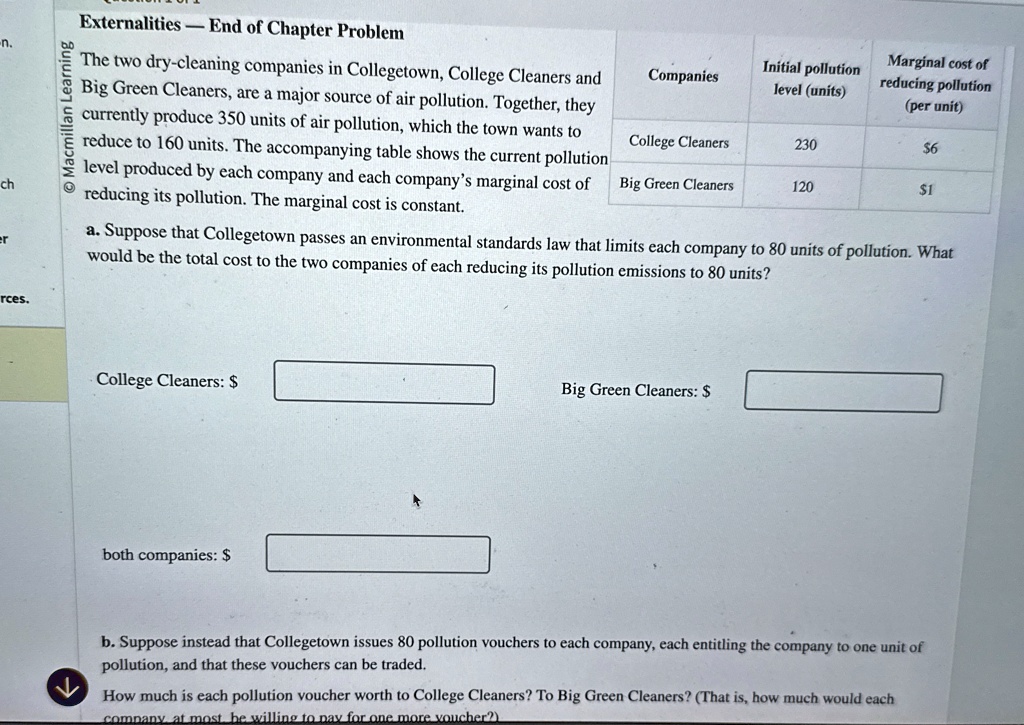
The two dry-cleaning companies in Collegetown, College Cleaners and Big Green Cleaners, are a major source of air pollution. Together, they currently produce 350 units of air pollution, which the town wants to reduce to 160 units. The accompanying table shows the current pollution level produced by each company and each company's marginal cost of reducing its pollution. The marginal cost is constant.
Companies Initial pollution level (units) Marginal cost of reducing pollution (per unit)
College Cleaners 230 $6
Big Green Cleaners 120 $1
a. Suppose that Collegetown passes an environmental standards law that limits each company to 80 units of pollution. What would be the total cost to the two companies of each reducing its pollution emissions to 80 units?
College Cleaners: $
Big Green Cleaners: $
both companies: $
b. Suppose instead that Collegetown issues 80 pollution vouchers to each company, each entitling the company to one unit of pollution, and that these vouchers can be traded.
How much is each pollution voucher worth to College Cleaners? To Big Green Cleaners? (That is, how much would each company at most be willing to pay for one more voucher?)