Kepler's great great great great granddaughter has discovered a new solar system similar to
ours. One of the closest planets to the system's sun is called PB3457 and another planet
further away is called PB6834. Here are the physical properties associated with the system's
sun and those planets:
$Mass_{PB3457} = 3.3 \times 10^{23} kg$
$Mass_{PB6834} = 1.0 \times 10^{26} kg$
$Mass_{NewSun} = 2.0 \times 10^{30} kg$
$Radius_{PB3457} = 2,500 km$
$Radius_{PB6834} = 25,000 km$
$Radius_{NewSun} = 700,000 km$
Note: This problem will result in very large distances. I will be looking at the method to
ensure that the answer was calculated properly. Even if your answer is very close to the
correct answer, it could still be incorrect due to the method taken.
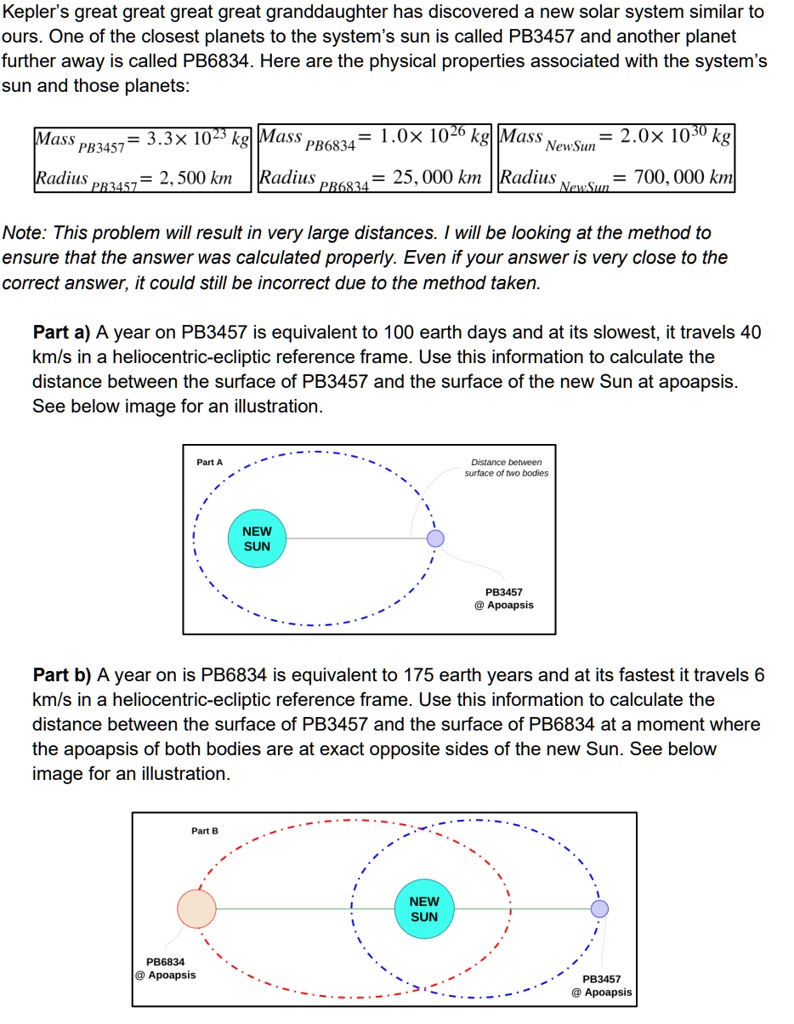
Part a) A year on PB3457 is equivalent to 100 earth days and at its slowest, it travels 40
km/s in a heliocentric-ecliptic reference frame. Use this information to calculate the
distance between the surface of PB3457 and the surface of the new Sun at apoapsis.
See below image for an illustration.
Part A
NEW
SUN
Distance between
surface of two bodies
PB3457
@ Apoapsis
Part b) A year on is PB6834 is equivalent to 175 earth years and at its fastest it travels 6
km/s in a heliocentric-ecliptic reference frame. Use this information to calculate the
distance between the surface of PB3457 and the surface of PB6834 at a moment where
the apoapsis of both bodies are at exact opposite sides of the new Sun. See below
image for an illustration.
PB6834
@Apoapsis
Part B
NEW
SUN
PB3457
@ Apoapsis