DEFINITION
If f(x) is discontinuous at a, then
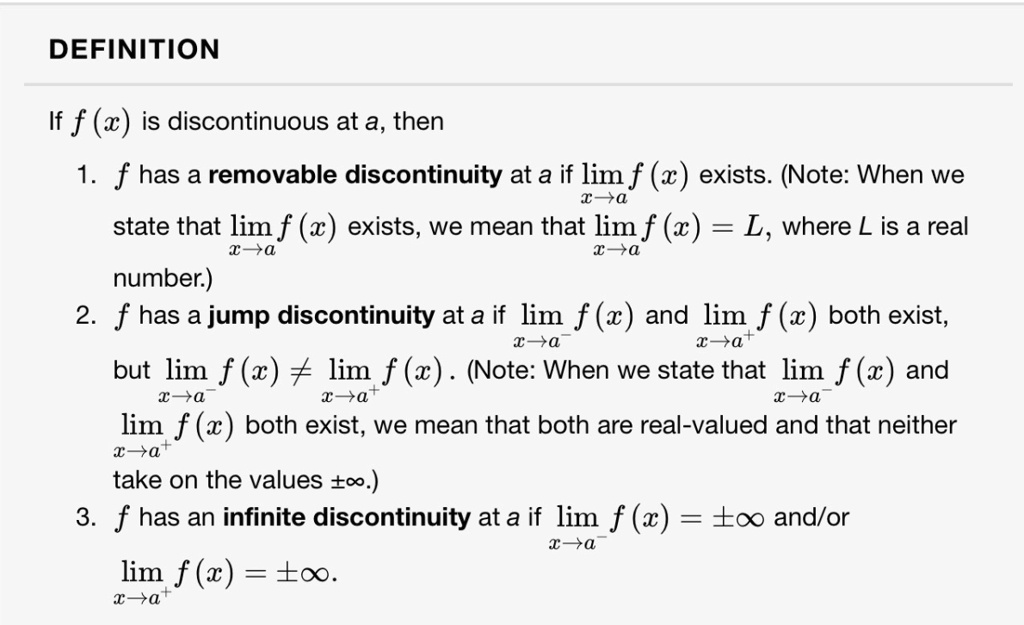
f has a removable discontinuity at a if lim_(x->a)f(x) exists. (Note: When we
state that lim_(x->a)f(x) exists, we mean that lim_(x->a)f(x)=L, where L is a real
number.)
f has a jump discontinuity at a if lim_(x->a^(-))f(x) and lim_(x->a^(+))f(x) both exist,
but lim_(x->a^(-))f(x)!=lim_(x->a^(+))f(x). (Note: When we state that lim_(x->a^(-))f(x) and
lim_(x->a^(+))f(x) both exist, we mean that both are real-valued and that neither
take on the values +-infty .)
f has an infinite discontinuity at a if lim_(x->a^(-))f(x)=+-infty and/or
lim_(x->a^(+))f(x)=+-infty .
DEFINITION
If f () is discontinuous at a, then
1. f has a removable discontinuity at a if lim f () exists. (Note: When we
state that lim f () exists, we mean that lim f () = L, where L is a real x-a D number.)
2. f has a jump discontinuity at a if lim f () and lim f () both exist.
but lim f () lim f (). (Note: When we state that lim f () and x-a C- lim f () both exist, we mean that both are real-valued and that neither c-o
take on the values o.)
3. f has an infinite discontinuity at a if lim f () = oo and/or
lim f(x)=o