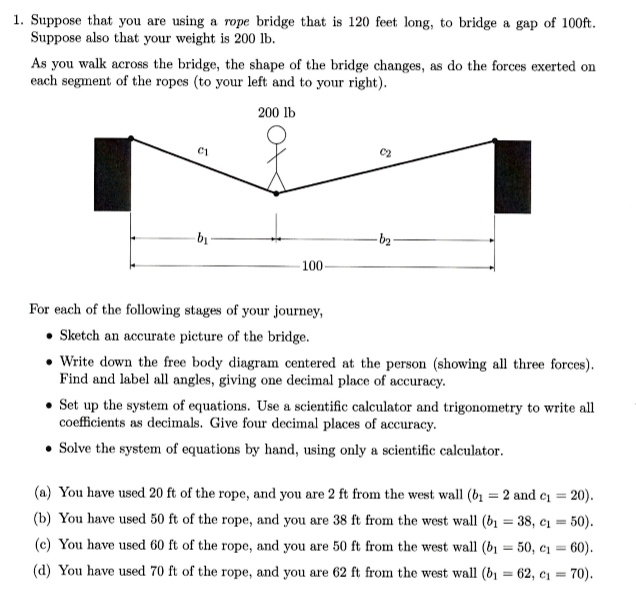
1. Suppose that you are using a rope bridge that is 120 feet long, to bridge a gap of 100ft.
Suppose also that your weight is 200 lb.
As you walk across the bridge, the shape of the bridge changes, as do the forces exerted on
each segment of the ropes (to your left and to your right).
$c_1$
200 lb
$c_2$
$b_1$
$b_2$
100
For each of the following stages of your journey,
• Sketch an accurate picture of the bridge.
• Write down the free body diagram centered at the person (showing all three forces).
Find and label all angles, giving one decimal place of accuracy.
• Set up the system of equations. Use a scientific calculator and trigonometry to write all
coefficients as decimals. Give four decimal places of accuracy.
• Solve the system of equations by hand, using only a scientific calculator.
(a) You have used 20 ft of the rope, and you are 2 ft from the west wall ($b_1$ = 2 and $c_1$ = 20).
(b) You have used 50 ft of the rope, and you are 38 ft from the west wall ($b_1$ = 38, $c_1$= 50).
(c) You have used 60 ft of the rope, and you are 50 ft from the west wall ($b_1$ = 50, $c_1$ = 60).
(d) You have used 70 ft of the rope, and you are 62 ft from the west wall ($b_1$ = 62, $c_1$ = 70).