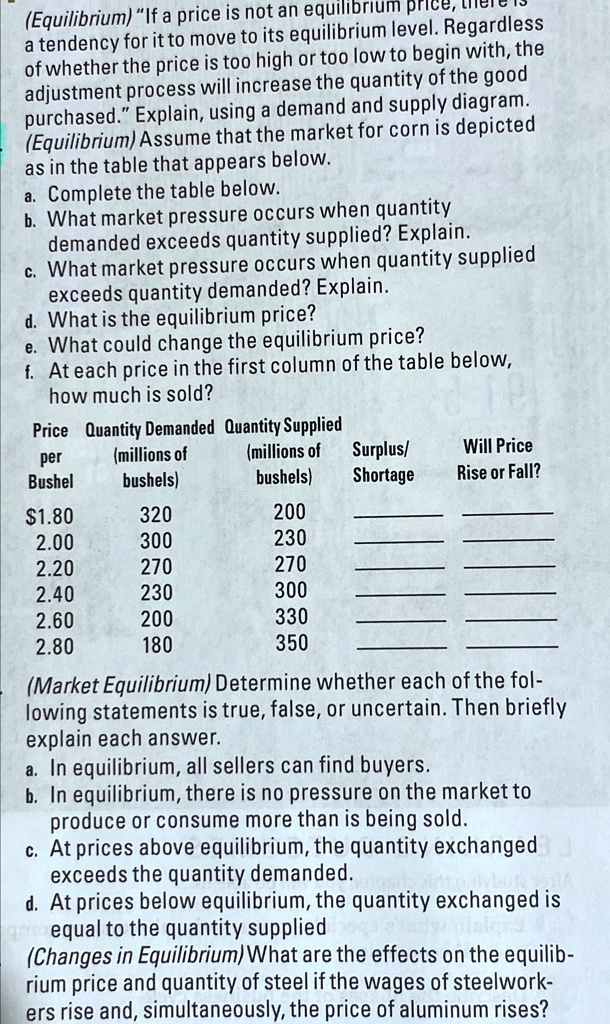
(Equilibrium) "If a price is not an equilibrium price, there is a tendency for it to move to its equilibrium level. Regardless of whether the price is too high or too low to begin with, the adjustment process will increase the quantity of the good purchased." Explain, using a demand and supply diagram.
(Equilibrium) Assume that the market for corn is depicted as in the table that appears below.
a. Complete the table below.
b. What market pressure occurs when quantity demanded exceeds quantity supplied? Explain.
c. What market pressure occurs when quantity supplied exceeds quantity demanded? Explain.
d. What is the equilibrium price?
e. What could change the equilibrium price?
f. At each price in the first column of the table below, how much is sold?
Price\ per Bushel & Quantity Demanded \ (millions of bushels) & Quantity Supplied \ (millions of bushels) & Surplus/Shortage & Will Price Rise or Fall?\$1.80 & 320 & 200 & & \
2.00 & 300 & 230 & & \
2.20 & 270 & 270 & & \
2.40 & 230 & 300 & & \
2.60 & 200 & 330 & & \
2.80 & 180 & 350 & &
(Market Equilibrium) Determine whether each of the following statements is true, false, or uncertain. Then briefly explain each answer.
a. In equilibrium, all sellers can find buyers.
b. In equilibrium, there is no pressure on the market to produce or consume more than is being sold.
c. At prices above equilibrium, the quantity exchanged exceeds the quantity demanded.
d. At prices below equilibrium, the quantity exchanged is equal to the quantity supplied
(Changes in Equilibrium) What are the effects on the equilibrium price and quantity of steel if the wages of steelworkers rise and, simultaneously, the price of aluminum rises?