Definition
Associativity allows us to write an expression of the form $x_1 \cdot x_2 \cdots x_n$ (where
$x_1, \dots, x_n \in G$) without ambiguity. Let $x \in G$. For any positive integer $n$, define
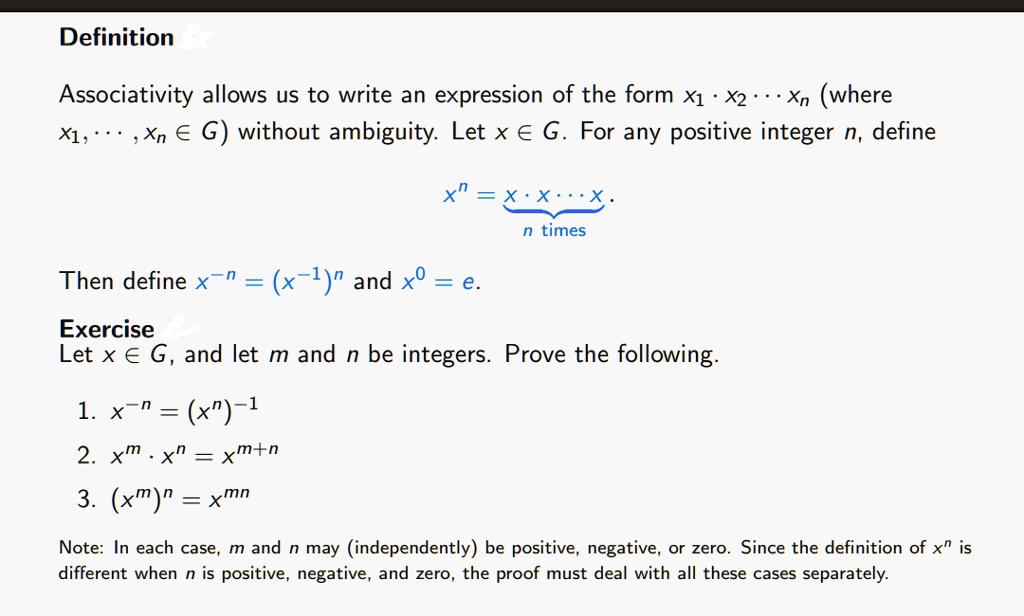
$x^n = \underbrace{x \cdot x \cdots x}_{n \text{ times}}$.
Then define $x^{-n} = (x^{-1})^n$ and $x^0 = e$.
Exercise
Let $x \in G$, and let $m$ and $n$ be integers. Prove the following.
1. $x^{-n} = (x^n)^{-1}$
2. $x^m \cdot x^n = x^{m+n}$
3. $(x^m)^n = x^{mn}$
Note: In each case, $m$ and $n$ may (independently) be positive, negative, or zero. Since the definition of $x^n$ is
different when $n$ is positive, negative, and zero, the proof must deal with all these cases separately.