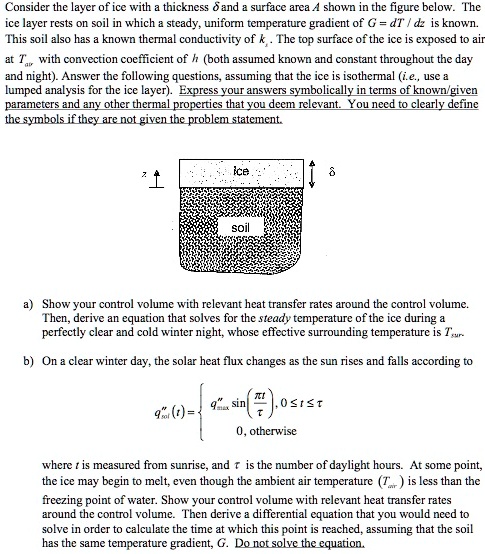
Consider the layer of ice with a thickness \(\delta\) and a surface area \(A\) shown in the figure below. The ice layer rests on soil in which a steady, uniform temperature gradient of \(G = \frac{dT}{dz}\) is known. This soil also has a known thermal conductivity of \(k\). The top surface of the ice is exposed to air at \(T_{\infty}\) with convection coefficient of \(h\) (both assumed known and constant throughout the day and night). Answer the following questions, assuming that the ice is isothermal (i.e., use a lumped analysis for the ice layer). Express your answers symbolically in terms of known/given parameters and any other thermal properties that you deem relevant. You need to clearly define the symbols if they are not given the problem statement.
a) Show your control volume with relevant heat transfer rates around the control volume. Then, derive an equation that solves for the steady temperature of the ice during a perfectly clear and cold winter night, whose effective surrounding temperature is \(T_{sur}\)
b) On a clear winter day, the solar heat flux changes as the sun rises and falls according to
\(q''_{sol}(t) = \begin{cases} q''_{max} \sin(\frac{\pi t}{\tau}) & 0 \le t \le \tau\\ 0 & \text{otherwise} \end{cases}\)
where \(t\) is measured from sunrise, and \(\tau\) is the number of daylight hours. At some point, the ice may begin to melt, even though the ambient air temperature \((T_{\infty})\) is less than the freezing point of water. Show your control volume with relevant heat transfer rates around the control volume. Then derive a differential equation that you would need to solve in order to calculate the time at which this point is reached, assuming that the soil has the same temperature gradient, \(G\). Do not solve the equation.