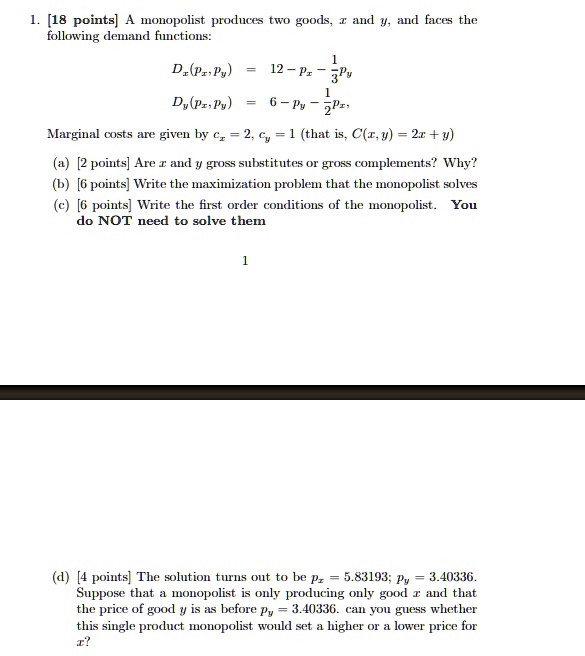
1. [18 points] A monopolist produces two goods, $x$ and $y$, and faces the
following demand functions:
$D_x(p_x, p_y) = 12 - p_x - \frac{1}{3}p_y$
$D_y(p_x, p_y) = 6 - p_y - \frac{1}{2}p_x$
Marginal costs are given by $c_x = 2$, $c_y = 1$ (that is, $C(x, y) = 2x + y$)
(a) [2 points] Are $x$ and $y$ gross substitutes or gross complements? Why?
(b) [6 points] Write the maximization problem that the monopolist solves
(c) [6 points] Write the first order conditions of the monopolist. You
do NOT need to solve them
(d) [4 points] The solution turns out to be $p_x = 5.83193$; $p_y = 3.40336$.
Suppose that a monopolist is only producing only good $x$ and that
the price of good $y$ is as before $p_y = 3.40336$. can you guess whether
this single product monopolist would set a higher or a lower price for
x?