Ace - AI Tutor
Ask Our Educators
Textbooks
My Library
Flashcards
Scribe - AI Notes
Notes & Exams
Download App
joseph brewer

joseph b.

Divider

Questions asked

BEST MATCH

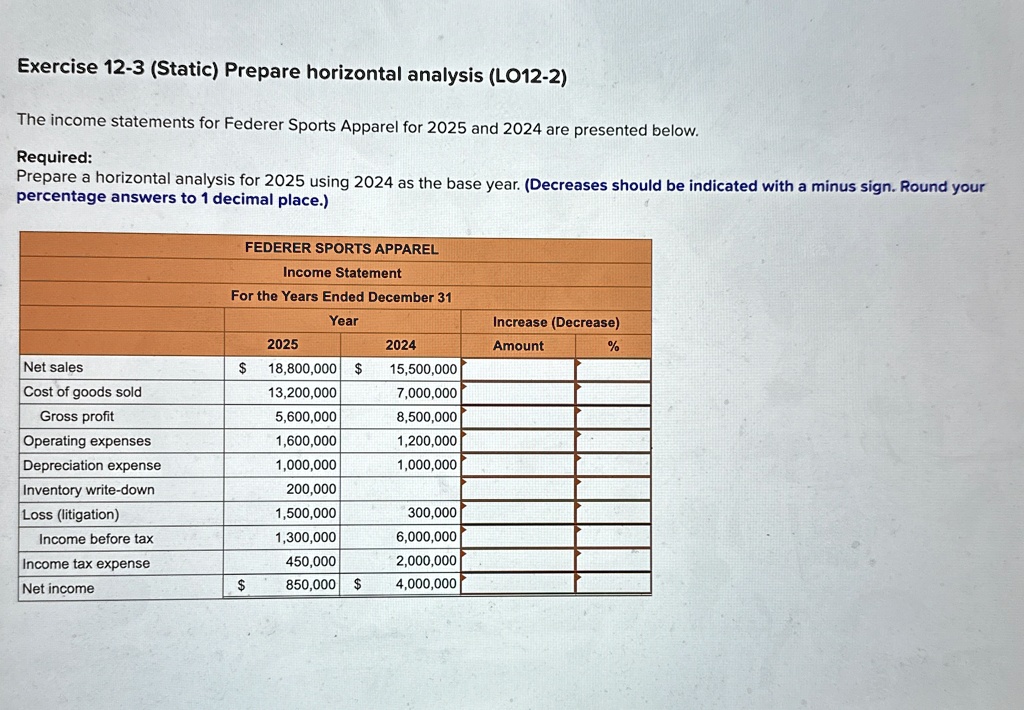
Exercise 12-3 (Static) Prepare horizontal analysis (LO12-2) The income statements for Federer Sports Apparel for 2025 and 2024 are presented below. Required: Prepare a horizontal analysis for 2025 using 2024 as the base year. (Decreases should be indicated with a minus sign. Round your percentage answers to 1 decimal place.) FEDERER SPORTS APPAREL Income Statement For the Years Ended December 31 Year 2025 2024 Increase (Decrease) Amount % Net sales $ 18,800,000 $ 15,500,000 Cost of goods sold 13,200,000 7,000,000 Gross profit 5,600,000 8,500,000 Operating expenses 1,600,000 1,200,000 Depreciation expense 1,000,000 1,000,000 Inventory write-down 200,000 Loss (litigation) 1,500,000 300,000 Income before tax 1,300,000 6,000,000 Income tax expense 450,000 2,000,000 Net income $ 850,000 $ 4,000,000
View Answer
divider
BEST MATCH

In case of an airfoil, the separation of flow occurs a) at the extreme rear of body b) at the extreme front of body c) midway between rear and front of body d) anywhere between rear and front of body depending upon Reynolds number

View Answer
divider
BEST MATCH

Your current directory should still be cse220-p01. Make dir03 your current directory. Now using one command, copy foo from dir03 to dir01.

View Answer
divider
BEST MATCH

Which of the following is/are considered part of the first line of defense? Mucous membranes, red blood cells, leukocytes. All of these are correct.

View Answer
divider
BEST MATCH

36. According to liquidity-preference theory, why is the money-demand curve downward sloping? a. because interest rates rise as the Bank of Canada reduces the quantity of money demanded b. because interest rates fall as the Bank of Canada reduces the supply of money c. because people will want to hold less money as the cost of doing so falls d. because people will want to hold more money as the cost of doing so rises 37. According to liquidity-preference theory, if the price level increases, how do the equilibrium interest rate and the aggregate quantity of goods change? a. The interest rate and the quantity demanded rise. b. The interest rate rises and the quantity demanded falls c. The interest rate falls and the quantity demanded rises. d. The interest rate and the quantity demanded fall.

View Answer
divider
BEST MATCH

13. A cable that weighs 2 lb/ft is used to lift 800 lb of coal up a mine shaft 500 ft deep. Find the work done.

View Answer
divider
BEST MATCH

A company sells a product for $78 each. The variable costs are $18 per unit and fixed costs are $27,660 per month. a

View Answer
divider
BEST MATCH

Find a system of differential equations and initial conditions for the currents in the network given in the schematic diagram. Assume that all initial currents are zero. Solve for the currents in each branch of the network. What are the system of equations? $I_3 = \frac{dq}{dt}$ where $q$ is the charge on the capacitor. A. $4 - 4\frac{dl_1}{dt} - 14I_2 = 0$, $I_2 + \frac{dq}{dt} - I_1 = 0$ and $-2\frac{dq}{dt} - 6q + 14I_2 = 0$ B. $4 - 4I_1 - 14\frac{dl_2}{dt} = 0$, $I_2 + \frac{dq}{dt} - I_1 = 0$ and $-2\frac{dq}{dt} - 6q + 14\frac{dl_2}{dt} = 0$ C. $4 + 4I_1 + 14\frac{dl_2}{dt} = 0$, $I_2 + \frac{dq}{dt} + I_1 = 0$ and $2\frac{dq}{dt} + 6q + 14I_2 = 0$ D. $4 + 4\frac{dl_1}{dt} + 14I_2 = 0$, $I_2 + \frac{dq}{dt} + I_1 = 0$ and $2\frac{dq}{dt} + 6q + 14I_2 = 0$ What are the initial conditions? $I_1(0) = I_2(0) = I_3(0) = What are the currents in each branch of the network? $I_1 = I_2 = I_3 = (Type exact answers.)

View Answer
divider
BEST MATCH

Calculate each of the limits in Exercises 49-64. Some of these limits are made easier by considering the logarithm of the limit first, and some are not. 49. $\lim_{x \to 0^{+}} x^{\ln x}$ 51. $\lim_{x \to 2^{+}} (x - 2)^{x^{2} - 4}$ 53. $\lim_{x \to 1^{+}} x^{1/(x - 1)}$ 55. $\lim_{x \to \infty} x^{1/x}$ 57. $\lim_{x \to \infty} \left(\frac{1}{x + 1}\right)^{x}$ 59. $\lim_{x \to 1^{+}} (x - 1)^{\ln x}$ 61. $\lim_{x \to 0^{+}} x^{\sin x}$ 63. $\lim_{x \to 0^{+}} (\cos x)^{1/x}$ 50. $\lim_{x \to \infty} x^{\ln x}$ 52. $\lim_{x \to 0^{+}} (x^{2} + 1)^{x}$ 54. $\lim_{x \to 0^{+}} x^{2x}$ 56. $\lim_{x \to \infty} \left(\frac{1}{x}\right)^{x}$ 58. $\lim_{x \to \infty} \left(\frac{x}{x - 1}\right)^{x}$ 60. $\lim_{x \to 1^{+}} (\ln x)^{x - 1}$ 62. $\lim_{x \to 0^{+}} (\sin 3x)^{2x}$ 64. $\lim_{x \to 0} (1 - \cos x)^{x}$

View Answer
divider
BEST MATCH

In a study on the relationship between sleep and stress, college students indicated how many hours they slept per day and their stress level on a scale of 1 to 10. The data appear below. SLEEP STRESS 4 7 7 6 8 2 9 5 2 9 6 4 7 5 3 8 1. Sketch a scatter plot of the data. 2. Calculate the correlation coefficient. 3. Based on this finding, describe in words the relationship that the data suggests. Include both direction (i.e., positive or negative) and an interpretation. 4. How much variability in stress scores is accounted for by the number of hours slept per day? 5. What stress score would you predict for a student who sleeps 5 hours per day? 6. What is the amount of error, on average, that you would expect from making such a decision? 7. Does lack of sleep cause stress? What could be one alternate explanation for the findings?

View Answer
divider