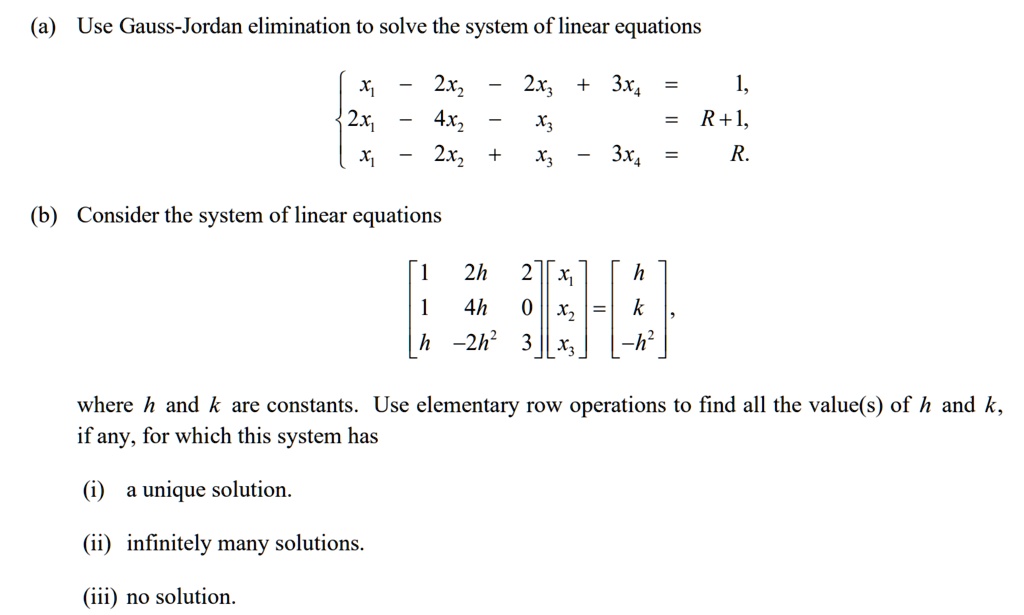
(a) Use Gauss-Jordan elimination to solve the system of linear equations
x_(1)-2x_(2)-2x_(3)+3x_(4),=,1,
2x_(1)-4x_(2)-x_(3),=,R+1,
x_(1)-2x_(2)+x_(3)-3x_(4),=,R.
(b) Consider the system of linear equations
[[1,2h,2],[1,4h,0],[h,-2h^(2),3]][[x_(1)],[x_(2)],[x_(3)]]=[[h],[k],[-h^(2)]],
where h and k are constants. Use elementary row operations to find all the value(s) of h and k,
if any, for which this system has
(i) a unique solution.
(ii) infinitely many solutions.
(iii) no solution.
(a) Use Gauss-Jordan elimination to solve the system of linear equations
x- 2x,- 2x + 3x4 = 1, 2x,- 4x,-x = R+1, x - 2x2 +x3 - 3x4 = R.
(b) Consider the system of linear equations
2h 1 4h 0 x2 h 2h2 3 x,
h
k
where h and k are constants. Use elementary row operations to find all the value(s) of h and k. if any, for which this system has
(i) a unique solution
(ii) infinitely many solutions.
(iii) no solution.