Ace - AI Tutor
Ask Our Educators
Textbooks
My Library
Flashcards
Scribe - AI Notes
Notes & Exams
Download App
Joseph Hsiao

Joseph H.

Divider

Questions asked

ANSWERED

David Nguyen verified

Numerade educator

21. f(x) = x sin x, a = 0, n = 4, -1 <= x <= 1 a) x^2 - 1/6 x^4 b) 0.041667 a) n f(x) = sin x put in x later 0 f(x) = sin x f(0) = 0 1 f'(x) = cos x f'(0) = 1 2 f''(x) = -sin x f''(0) = 0 3 f'''(x) = -cos x f'''(0) = -1 4 f^4(x) = sin x f^4(0) = 0 5 f^5(x) = cos x f^5(0) = 1 sum_{n=0}^{infinity} f^{(n)}(a)/n! (x-a)^n sum_{n=0}^{infinity} f^{(n)}(0)/n! (x)^n sin x = 0 + 1/1! x^1 + 0 - 1/3! x^3 + 0 + 1/5! x^5 x * sin x = x * [x - 1/6 x^3 + 1/120 x^5 ...] = x^2 - 1/6 x^4 + 1/120 x^6 ... n = 4 -> x^2 - 1/6 x^4

View Answer
divider
INSTANT ANSWER

\( \begin{array}{ll}f^{\prime}(x)=\cos x & f^{\prime}(0)=1 \\ f^{\prime \prime}(x)=-\sin x & f^{\prime \prime}(0)=0\end{array} \) \( \begin{array}{ll}f^{\prime \prime \prime}(x)=-\cos x & f^{(1)}(0)=-1 \\ f^{4}(x)=\sin x & f^{4}(0)=0\end{array} \) \( 5 \quad f^{5}(t)=\cos x \quad f 5(0)=1 \) \( \sum_{n=0}^{\infty} \frac{f^{(n)}(a)}{n !}(x-a)^{n} \) \( \sum_{n=0}^{\infty} \frac{f^{(n)}(0)}{a !}(x)^{n} \) \( \sin x=0+\frac{1}{11} x^{1}+0-\frac{1}{3 !} x^{3}+0+\frac{1}{5 !} x^{5} \) \( x \cdot \sin x=x \cdot\left[x-\frac{1}{6} x^{3}+\frac{1}{120} x^{5} \ldots 0\right] \) \( =\underbrace{x^{2}-\frac{1}{6} x^{4}}+\frac{1}{120} x^{6} \cdots \) \( n=4 \rightarrow x^{2}-\frac{1}{6} x^{4} \)

View Answer
divider
ANSWERED

David Nguyen verified

Numerade educator

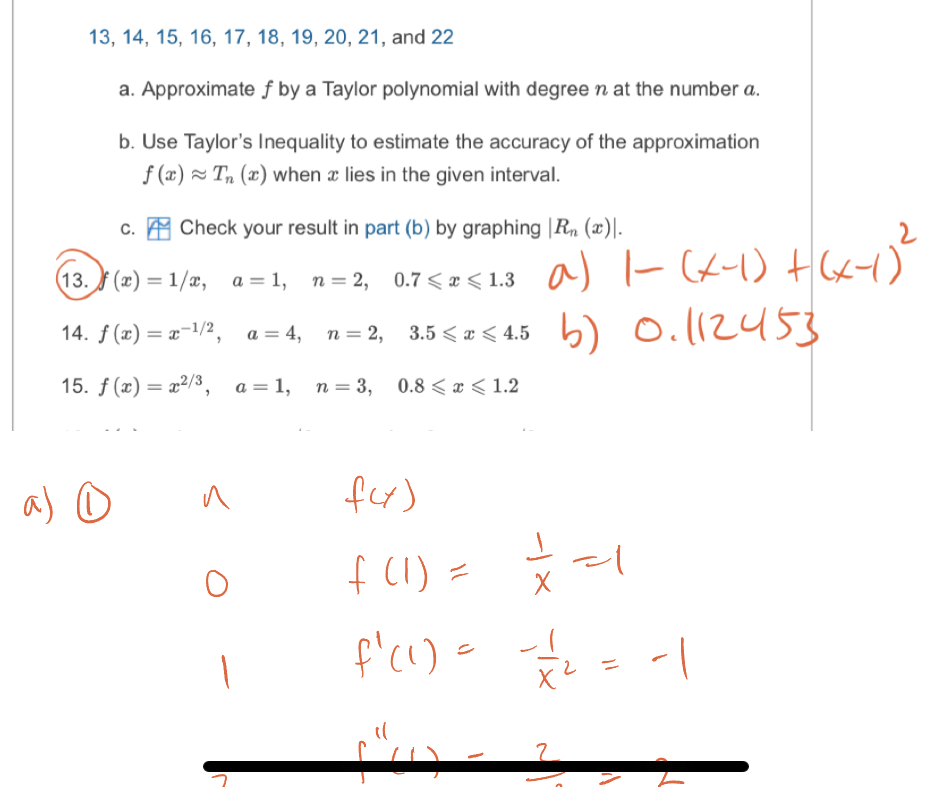
13, 14, 15, 16, 17, 18, 19, 20, 21, and 22 a. Approximate f by a Taylor polynomial with degree n at the number a. b. Use Taylor's Inequality to estimate the accuracy of the approximation f(x) ? Tn(x) when x lies in the given interval. c. Check your result in part (b) by graphing |Rn(x)|. 13. f(x) = 1/x, a = 1, n = 2, 0.7 ? x ? 1.3 a) 1 - (x-1) + (x-1)^2 14. f(x) = x^-1/2, a = 4, n = 2, 3.5 ? x ? 4.5 b) 0.112453 15. f(x) = x^2/3, a = 1, n = 3, 0.8 ? x ? 1.2 a) (1) n f(x) 0 f(1) = 1/x = 1 1 f'(1) = -1/x^2 = -1 2 f''(1) = 2/x^3 = 2
View Answer
divider
INSTANT ANSWER

\( 13,14,15,16,17,18,19,20,21 \), and 22 a. Approximate \( f \) by a Taylor polynomial with degree \( n \) at the number \( a \). b. Use Taylor's Inequality to estimate the accuracy of the approximation \( f(x) \approx T_{n}(x) \) when \( x \) lies in the given interval. c. \( \square \) Check your result in part (b) by graphing \( \left|R_{n}(x)\right| \). (13.) \( (x)=1 / x, \quad a=1, \quad n=2, \quad 0.7 \leqslant x \leqslant 1.3 \quad 0) \quad 1-(x-1)+(x-1)^{2} \) 14. \( \left.f(x)=x^{-1 / 2}, \quad a=4, \quad n=2, \quad 3.5 \leqslant x \leqslant 4.5 \quad b\right) \quad 0 .\{(2453 \) 15. \( f(x)=x^{2 / 3}, \quad a=1, \quad n=3, \quad 0.8 \leqslant x \leqslant 1.2 \)

View Answer
divider
ANSWERED

Ma. Theresa Alin verified

Numerade educator

10. f(x) = x / (2x^2 + 1) 11. f(x) = (x - 1) / (x + 2) -1/2 - sum_{n=1}^{infinity} ((-1)^n 3x^n) / (2^{n+1}) (-2, 2) 12. f(x) = (x + a) / (x^2 + a^2), a > 0 a / (1 - r) f(x) = (x - 1) * (1 / (x + 2))

View Answer
divider
ANSWERED

Eleni Katirtzoglou verified

Numerade educator

[-4, 4] 23. ? (x+2)? / (2? ln n) n=2 to ?; 2, [-4, 0] 24. ? ?n (x-s)? | ((x+2)? 路 (x+2) / (2? 路 2 路 ln(n+1))) 路 (2? 路 ln n / (x+2)?) | | (x+2) ln n / (2 路 ln(n+1)) |

View Answer
divider
ANSWERED

Christopher Stanley verified

Numerade educator

sum_{n=2}^{infty} frac{1}{n} x^n 9. sum_{n=1}^{infty} frac{x^n}{n 3^n} 3, [-3, 3] 10. sum_{n=1}^{infty} n ratio test |frac{x^n cdot x}{(n+1) 3^n cdot 3} cdot frac{n 3^n}{x^n}| |frac{xn}{3(n+1)}| |frac{x}{3}| lim_{n o infty} |frac{n}{n+1}| = 1 |frac{x}{3}| < 1 |x| < 3 radius = 3 -3 < x < 3 sum_{n=1}^{infty} frac{-3^n}{n 3^n} sum frac{-1^n cdot 3^n}{}

View Answer
divider
INSTANT ANSWER

23. [0/3 Points] DETAILS Consider the following function. \begin{tabular}{|l|l|l|} \hline PREVIOUS ANSWERS & SCALC9 11.11.019.MI. & MY NOTES \\ \hline \end{tabular} ASK YOUR TEACHER \[ f(x)=e^{4 x^{2}}, \quad a=0, \quad n=3, \quad 0 \leq x \leq 0.2 \] (a) Approximate \( f \) by a Taylor polynomial with degree \( n \) at the number \( a \). \[ T_{3}(x)=1+4 x^{4} \times \] \( \left|R_{3}(x)\right| \leq \) (c) Check your result in part (b) by graphing \( \left|R_{n}(x)\right| \).

View Answer
divider
INSTANT ANSWER

Prove that the infinite series \( \sum_{k=1}^{\infty} \frac{1}{k^{2}+1} \) is bounded below by \( \frac{\pi}{4} \) and bounded above by \( \frac{2+\pi}{4} \).

View Answer
divider
ANSWERED

Amelia Hardy verified

Numerade educator

Consider the power series of ( g(x)=sum_{n=0}^{infty} frac{2^{n}(n !)^{2} x^{n}}{(2 n) !} ). Estimate ( int_{0}^{1} frac{g(x)-1}{x} d x ) leveraging the first three non-zero terms of this power series.

View Answer
divider