Name:
The Virtual Laboratory: Experiment
Projectile Motion Report
Intreduction
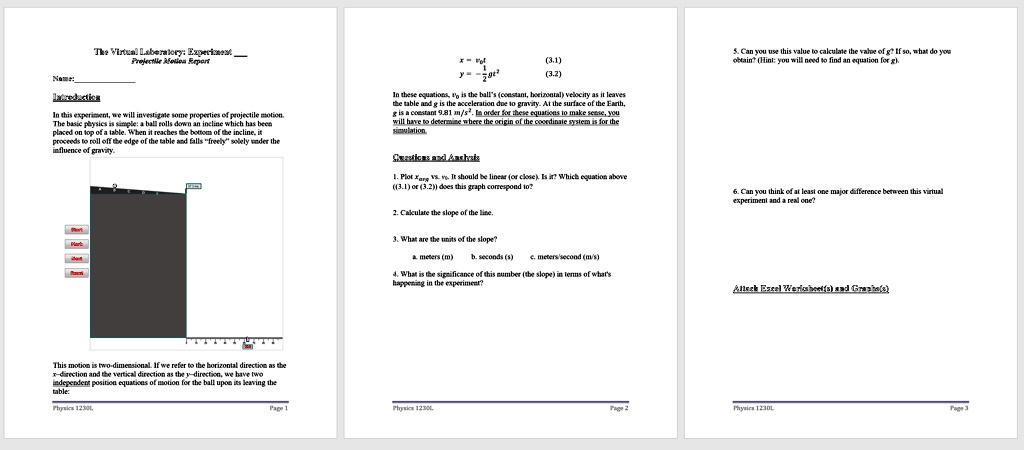
In this experiment, we will investigate some properties of projectile motion.
The basic physics is simple: a ball rolls down an incline which has been
placed on top of a table. When it reaches the bottom of the incline, it
proceeds to roll off the edge of the table and falls "freely" solely under the
influence of gravity.
$x = v_ot$
$y = -\frac{1}{2}gt^2$
(3.1)
(3.2)
In these equations, $v_o$ is the ball's (constant, horizontal) velocity as it leaves
the table and $g$ is the acceleration due to gravity. At the surface of the Earth,
$g$ is a constant 9.81 m/s$^2$. In order for these equations to make sense, you
will have to determine where the origin of the coordinate system is for the
simulation
Questions and Analysis
1. Plot $x_{avg}$ vs. $v_o$. It should be linear (or close). Is it? Which equation above
((3.1) or (3.2)) does this graph correspond to?
2. Calculate the slope of the line.
3. What are the units of the slope?
a. meters (m) b. seconds (s) c. meters/second (m/s)
4. What is the significance of this number (the slope) in terms of what's
happening in the experiment?
5. Can you use this value to calculate the value of $g$? If so, what do you
obtain? (Hint: you will need to find an equation for $g$).
6. Can you think of at least one major difference between this virtual
experiment and a real one?
Attock Excel Worksheet(s) and Graph(s)
This motion is two-dimensional. If we refer to the horizontal direction as the
x-direction and the vertical direction as the y-direction, we have two
independent position equations of motion for the ball upon its leaving the
table:
Physics 1230L
Physics 1230L.
Physics 1230L