Questions asked
When a dermatologist suspects that skin may show signs of disease or cancer they will likely take a skin biopsy for analysis. This process involves removing a small portion of the affected skin. In a 2017 study, the proportion of skin biopsies that came back as melanoma was p=0.014. If the study included 254 biopsies, are the conditions met to use a normal distribution approximation?
Which of the following statements about pulmonary edema is/are correct? I. Pulmonary edema is induced by pulmonary hypotension. II. Diffusion impairment occurs before hypoventilation. III. Hypercapnia occurs before hypoxemia. Question 11Select one: a. II only b. I and II only c. I only d. II and III only e. I, II and III
Peptide A: ADEPRAPMKGCHMPSDFKQA Please select all of the statements below that accurately describe peptide A. Question 1 options: DNFB reacts with EXACTLY 3 primary amino groups in peptide A. After iodoacetate reacts with peptide A, the covalently modified peptide could react with a second molecule of peptide A to form a disulfide bridge, but only if the peptides are both first treated with mercaptoethanol to disrupt the thioether modification. Digesting peptide A with trypsin generates EXACTLY 4 fragments. Digesting peptide A with cyanogen bromide generates EXACTLY 3 fragments.
Genetic information in the cell is held by information molecules, including all EXCEPT which of the following? ? View Available Hint(s) O phospholipids O RNAs O DNAs O polypeptides Submit Provide Feedback
Question 5 (1 point) Which of the following is not a cause of a thinning disc: fibroblast cell death spinal stenosis an increase in osmotic potential intervertebral disc desiccation
In the figure shown below, tan \theta =
Find the work $W$ done by the force field $\mathbf{F}(x, y, z) = 28x\mathbf{i} + 8y\mathbf{j} + 6\mathbf{k}$ in moving an object along the helix $\mathbf{r} = \mathbf{r}(t) = \sin(t)\mathbf{i} + \cos(t)\mathbf{j} + t\mathbf{k}$, $0 \le t \le \pi$.
5. Let R be the region enclosed between the curves: y=?x-1, x=1, y=2. (i) Given an integral which computes the volume of the solid obtained when A is rotated around the x-axis. (Do NOT evaluate the integral) $V = \int_1^2 \pi (\sqrt{x-1})^2 dx$ (ii). Given an integral which computes the volume of the solid obtained when A is rotated around the y-axis. (Do NOT evaluate the integral) $\int_0^2 \pi ((y^2+1))^2 dy$ (iii). Given an integral which computes the volume of the solid obtained when A is rotated around y = 3. (Do NOT evaluate the integral) $V = \int_0^2 \pi (3 - y^2)^2 dy$ (iv). Given an integral which computes the volume of the solid obtained when A is rotated around the x = 6. (Do NOT evaluate the integral) $V = \int_1^2 \pi (6^2 - (\sqrt{x-1})^2) dx$
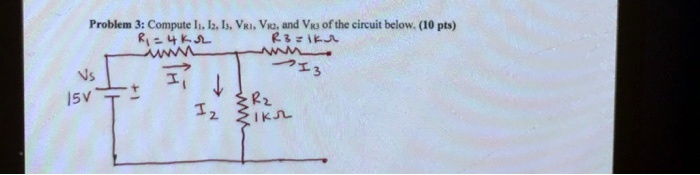
Problem 3: Compute $I_1$, $I_2$, $I_3$, $V_{R1}$, $V_{R2}$, and $V_{R3}$ of the circuit below. (10 pts) $R_1 = 4 k\Omega$ $R_3 = 1 k\Omega$ $V_S$ $15V$ $R_2$ $1 k\Omega$
Distinguish carefully between (a) the market period, (b) the short run, and (c) the long run. Explain your answer. (needs to be at least 100 words)