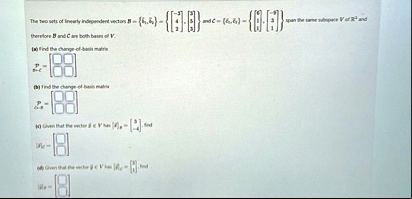
The two sets of linearly independent vectors $B = \{\vec{b_1}, \vec{b_2}\} = \left\{ \begin{bmatrix} -3 \\ 4 \\ 2 \end{bmatrix}, \begin{bmatrix} 3 \\ 5 \\ 3 \end{bmatrix} \right\}$ and $C = \{\vec{c_1}, \vec{c_2}\} = \left\{ \begin{bmatrix} 6 \\ 1 \\ 1 \end{bmatrix}, \begin{bmatrix} -9 \\ 3 \\ 1 \end{bmatrix} \right\}$ span the same subspace $V$ of $\mathbb{R}^3$ and therefore $B$ and $C$ are both bases of $V$.
(a) Find the change-of-basis matrix
$P_{B \leftarrow C} = \begin{bmatrix} \\ \\ \end{bmatrix}$
(b) Find the change of basis matrix
$P_{C \leftarrow B} = \begin{bmatrix} \\ \\ \end{bmatrix}$
(c) Given that the vector $\vec{v} \in V$ has $[\vec{v}]_B = \begin{bmatrix} 3 \\ -4 \end{bmatrix}$, find
$[\vec{v}]_C = \begin{bmatrix} \\ \\ \end{bmatrix}$
(d) Given that the vector $\vec{v} \in V$ has $[\vec{v}]_C = \begin{bmatrix} 3 \\ 1 \end{bmatrix}$, find
$[\vec{v}]_B = \begin{bmatrix} \\ \\ \end{bmatrix}$