Ace - AI Tutor
Ask Our Educators
Textbooks
My Library
Flashcards
Scribe - AI Notes
Notes & Exams
Download App
joseph izquierdo

joseph i.

Divider

Questions asked

BEST MATCH

The 54 th percentile in a large data set is 98.6 . Approximately what percentage of the observations are greater than 98.6 ? 54% 78.6% 46% 50% 1.4%

View Answer
divider
BEST MATCH

In a eukaryotic cell, which enzyme catalyzes the transcription of DNA? Answers: A - D A Helicase B Protein kinase C C RNA polymerase II D Restriction enzyme II

View Answer
divider
BEST MATCH

UIN/Downloads/\%231\%20Mol\%20Bio\%20Restriction\%20Analysis\%20QUESTIONS.pdf (T) a? Ask Copilot 1 of 2 Complete the following problems. Restriction enzymes (REs), which cut D NA at specific sequences, are classic tools in molecular biology. Because of their specificity in cutting DNA, REs can be used to "map" DNA sequences by analyzing the fragments generated upon restriction digest, as in the example shown in Figure 1. Your task is to study the circular plasmid, pMBBS, through restriction digests. You subjected the pMBBS plasmid to complete digestion by different combinations of three REs (EcoRI, BamHI, and Xhol), and analyzed the results on an agarose gel, shown below. Using the data you can glean from this gel, answer the questions that follow. \begin{tabular}{|c|c|c|c|c|c|c|c|c|} \hline EcoRI & - & + & - & - & + & & - & \\ \hline BamHI & - & - & + & - & + & + & + & ond \\ \hline Xhol & - & - & - & + & - & + & + & lacder \\ \hline \end{tabular} \( \square \) \begin{tabular}{c|c} & \\ \hline & \\ \hline \end{tabular} *The same total amount of DNA was loaded in each lane. VC 100bp Plus DNA ladder from Vivantis Technologies

View Answer
divider
BEST MATCH

Question 3 Homework • Unanswered • Due Sep 8th, 11:59 PM The law of supply states that ceteris paribus: Select an answer and submit. For keyboard navigation, use the up/down arrow keys to select an answer. a a greater quantity will be supplied at a higher price than at a lower price. b a greater quantity will be supplied at a lower price than at a higher price. c supply and price are positively (directly) related. d supply and price are negatively (inversely) related. swered • 2 attempts left

View Answer
divider
BEST MATCH

Can Ecotricity's highway expansion meet the expected charging demand (based on traffic flow) using only public chargers?

View Answer
divider
BEST MATCH

Use the definition of a Taylor series to find the first four nonzero terms of the series for $f(x)$ centered at the given value of $a$. (from 11.10, scan/upload work into Canvas. $f(x) = \frac{7}{1 + x}$, $a = 2$

View Answer
divider
BEST MATCH

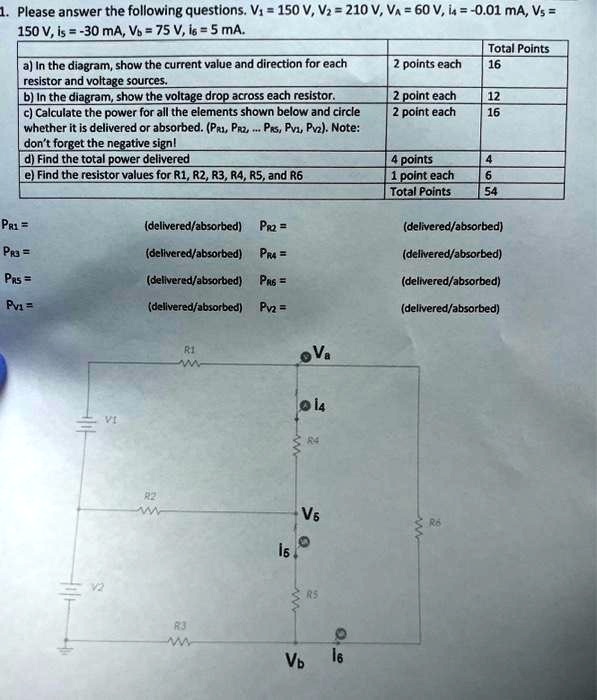
1. Please answer the following questions. V? = 150 V, V? = 210 V, V? = 60 V, I? = -0.01 mA, V? = 150 V, I? = -30 mA, V? = 75 V, I? = 5 mA. a) In the diagram, show the current value and direction for each resistor and voltage sources. b) In the diagram, show the voltage drop across each resistor. c) Calculate the power for all the elements shown below and circle whether it is delivered or absorbed. (P<sub>R1</sub>, P<sub>R2</sub>, ... P<sub>R5</sub>, P<sub>V1</sub>, P<sub>V2</sub>). Note: don't forget the negative sign! d) Find the total power delivered e) Find the resistor values for R1, R2, R3, R4, R5, and R6 2 points each Total Points 16 2 point each 12 2 point each 16 4 points 4 1 point each 6 Total Points 54 P<sub>R1</sub> = (delivered/absorbed) P<sub>R2</sub> = (delivered/absorbed) P<sub>R3</sub> = (delivered/absorbed) P<sub>R4</sub> = (delivered/absorbed) P<sub>R5</sub> = (delivered/absorbed) P<sub>R6</sub> = (delivered/absorbed) P<sub>V1</sub> = (delivered/absorbed) P<sub>V2</sub> = (delivered/absorbed)
View Answer
divider
BEST MATCH

3. An organic compound (C,H,;O) shows its principal infrared absorption at 2900-3050, 1760, 1460, and 1380 cm-1. Its 1H- NMR spectrum shows only a singlet at s 1.1 ppm.

View Answer
divider
BEST MATCH

3- Use the mesh current method to find the voltage $v_o$ in the following circuit.

View Answer
divider
BEST MATCH

Find the gradient of the function at the given point.\ $f(x, y) = 2x + 4y^2 + 10$, $(2, 1)$\ $\nabla f(2, 1) = $

View Answer
divider