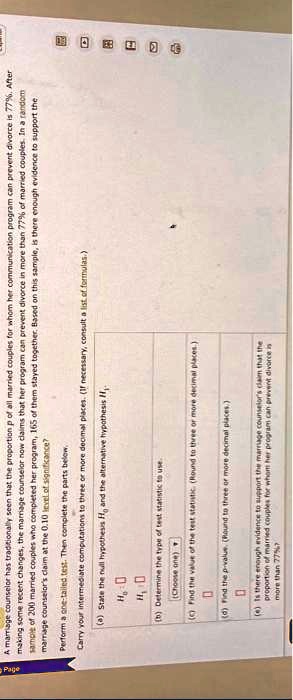
A marriage counselor has traditionally seen that the proportion p of all married couples for whom her communication program can prevent divorce is 77%. After
making some recent changes, the marriage counselor now claims that her program can prevent divorce in more than 77% of married couples. In a random
sample of 200 married couples who completed her program, 165 of them stayed together. Based on this sample, is there enough evidence to support the
marriage counselor's claim at the 0.10 level of significance?
Perform a one-tailed test. Then complete the parts below.
Carry your intermediate computations to three or more decimal places. (If necessary, consult a list of formulas.)
(a) State the null hypothesis $H_0$, and the alternative hypothesis $H_1$
$H_0:$
$H_1:$
(b) Determine the type of test statistic to use.
(Choose one)
(c) Find the value of the test statistic. (Round to three or more decimal places.)
(d) Find the p-value. (Round to three or more decimal places.)
(e) Is there enough evidence to support the marriage counselor's claim that the
proportion of married couples for whom her program can prevent divorce is
more than 77%?