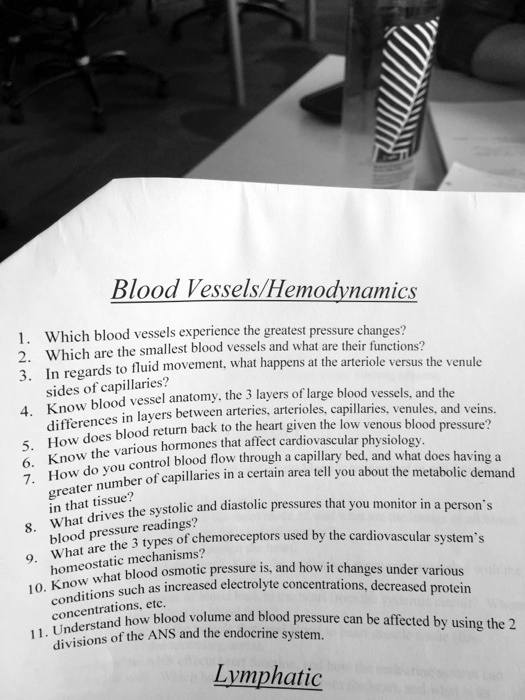
Blood Vessels/Hemodynamics
1. Which blood vessels experience the greatest pressure changes?
2. Which are the smallest blood vessels and what are their functions?
3. In regards to fluid movement, what happens at the arteriole versus the venule
sides of capillaries?
4. Know blood vessel anatomy, the 3 layers of large blood vessels, and the
differences in layers between arteries, arterioles, capillaries, venules, and veins.
5. How does blood return back to the heart given the low venous blood pressure?
7. How do you control blood flow through a capillary bed, and what does having a
6. Know the various hormones that affect cardiovascular physiology.
greater number of capillaries in a certain area tell you about the metabolic demand
in that tissue?
8. What drives the systolic and diastolic pressures that you monitor in a person's
blood pressure readings?
9. What are the types of chemoreceptors used by the cardiovascular system's
homeostatic mechanisms?
10. Know what blood osmotic pressure is, and how it changes under various
conditions such as increased electrolyte concentrations, decreased protein
concentrations, etc.
11. Understand how blood volume and blood pressure can be affected by using the 2
divisions of the ANS and the endocrine system.
Lymphatic